 Curio Class
Stories from Livy (set: early heroes of Rome)
Alfred J. Church, after Livy
The Story of Alba
King Tullus Hostilius, being newly come to the throne, looked about for an occasion of war; for the Romans had now for a long time been at peace. Now it chanced that in those days the men of Rome and the men of Alba had a quarrel, the one against the other, the country folk being wont to cross the border and to plunder their neighbours; and that ambassadors were sent from either city to seek restitution of such things as had been carried off. King Tullus said to his ambassador, "Delay not to do your business so soon as ye shall be come to Alba;" knowing that the men of Alba would certainly refuse to deliver up the things, and thinking that he could thus with a good conscience proclaim war against them. As for the ambassadors of Alba, when they were come to Rome, they made no haste about their business, but ate and drank, the King entertaining them with much courtesy and kindness. While therefore they feasted with him, there came back the ambassadors of Rome telling the King how they had made demand for the things carried off, and when the men of Alba had refused to deliver them, had declared war within the space of thirty days. Which when the King heard, he called to him the ambassadors of Alba, and said to them, "Wherefore are ye come to Rome? Set forth now your mission." Then the men, not knowing what had befallen, began to make excuse, saying, "We would not willingly say aught that should displease the King, but we are constrained by them that have sent us thither. We are come to ask for the things that your country folk have carried off. And, if ye will not deliver them up, we are bidden to declare war against you." To this Tullus made answer, "Now do I call the Gods to witness that ye men of Alba first refused to repair the thing that has been done amiss, and I pray them that they will bring all the blood of this war upon your heads." And with this message the men of Alba went home.
After this the two cities made great preparations for war. And because the men of Troy had built Lavinium, from which some going forth had set up the city of Alba, and from the royal house of Alba had come the founder of Rome, it was as though the children would fight against their fathers. Yet it came not to this, the matter being finished without a battle. The men of Alba first marched into the land of the Romans, having with them a very great army, and pitched their camp five miles from the city, digging about it a deep ditch. But while they lay in this camp their King Cluilius died, and a certain Mettus was made dictator in his room. Which when King Tullus heard, he became very bold, saying that the gods had smitten Cluilius for his wrong-doing, and would smite also the whole people of Alba. Whereupon he marched into the land of the Albans, leaving the enemy's camp to one side. And when these also had come forth against him, and the two armies were now drawn up in battle array, the one against the other, there came a messenger to King Tullus, saying that Mettus of Alba desired to have speech with him, having that to say to him which concerned the Romans not less than the men of Alba. Nor did King Tullus refuse to hear him, though indeed battle had pleased him better than speech. So when the King and certain nobles with him had gone forth into the open space that was between the two armies, and Mettus also with his companions had come to the same place, this last spake, saying, "I have heard King Cluilius that is dead affirm that your wrong-doing, ye men of Rome, in that ye would not deliver up the things that had been carried off, was the cause of this war; nor do I doubt but that thou, King Tullus, hast the same quarrel against us. Yet if we would speak that which is true rather than that which has a fair show, we should, I doubt not, confess that we, though we be both kinsmen and neighbours, are driven into this war by the lust of power. Now I say not whether this be just or no. Let others look to this; for I am not King of Alba, but captain of the host only. Yet there is a matter which I would fain call to thy mind, King. Thou knowest the Etruscans, how mighty they are both by land and sea; for indeed they are nearer by far to thee at Rome than to us at Alba. Bethink thee, therefore, how, when thou shalt give the signal of battle between thy army and our army, the same Etruscans will look on, rejoicing to see us fight together; and how, when the battle is ended, they will fall upon us, having us at disadvantage; for of a truth, whether ye or we prevail, we shall have but little strength remaining to us. If therefore we be not content with the freedom that we have, but must needs set on the chance of a die whether we shall be masters or servants, let us devise some way by which the one may win dominion over the other without great loss and shedding of blood." Now King Tullus was a great warrior, and would willingly have fought, being confident that he and his people would prevail; nevertheless the thing that Mettus of Alba had said pleased him. And when they came to consider the matter, there seemed by good fortune to be a way ready to their hands. There were in the army of Alba three brothers that had been born at one birth, whose name was Curiatius. And in the army of the Romans there were other three, and these born likewise at one birth, whose name was Horatius. Nor was there much difference in respect either of age or of strength between the brothers of Alba and the brothers of Rome. Then King Tullus and Mettus of Alba called for the brothers, and enquired of them whether they were willing to fight, each three for their own country, agreement being first made that that people should bear rule for ever whose champions should prevail in the battle. And as the young men were willing, a place was appointed for the battle and a time also. But first there was made a treaty in this fashion, for the fashion of making treaties is the same always, though their conditions be different. The herald said, "Wilt thou, King Tullus, that I make a treaty with the minister of the people of Alba?" And when the King answered "Yea," the herald said, "I will that thou give me the sacred herbs." Then the King made reply, "Take them, and see that they be clean." So the herald took them clean from the hill of the citadel. Having done this, he said to the King, "Dost thou appoint me to do the pleasure of the people of Rome, me and my implements and my attendants with me?" And the King answered, "So that it be without damage to the people of Rome." Then the herald appointed one Spurius to be minister that he should take the oath, and touched his hair with the sacred herbs. And when Spurius had taken the oath, and the conditions of the treaty had been read aloud, he spake, saying, "Hear thou, Jupiter, and thou also, minister of the people of Alba, and ye men of Alba; as these conditions have been duly read aloud this day from the beginning even to the end from these tables, and after the interpretation by which they may be the most easily understood, even so shall the Roman people abide by them. And if this people, acting by common consent, shall falsely depart from them, then do thou, O Jupiter, smite the Roman people, even as I shall smite this swine to-day. And smite them by so much the more strongly as thou art stronger than I." And when he had said this he smote the swine with a knife of stone. The men of Alba also took the oath, and confirmed it after their own fashion. These things having been thus ordered, the champions made them ready for battle. And first their fellows exhorted them severally in many words, saying that the gods of their country, their countrymen also and kinsfolk, whether they tarried at home or stood in the field, regarded their arms that day; and afterwards they went forth into the space that lay between the two armies. And these sat and watched them before their camps, being quit indeed of the peril of battle, but full of care how the matter should end, seeing that so great things, even sovereignty and freedom, should be decided by the valour and good luck of so few men. Then, the signal of battle being given, the three met the three with such courage and fierceness as though there were a whole army on either side. And as their swords rang against each other and flashed, all men trembled to see, and could scarcely speak or breathe for fear of what should happen. And for a while, in so narrow a space did the men fight, nought could be seen but how they swayed to and fro, and how the blood ran down upon the ground. But afterwards it was plain to see that of the three Romans two were fallen dead upon the ground, and that of the three champions of Alba each man was wounded.
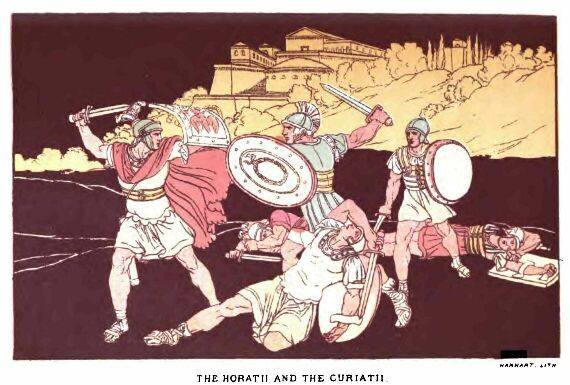
At this sight the Alban host shouted for joy, but the men of Rome had no more any hope but only fear, to think what should befall their one champion that had now three enemies against him. Now, by good luck, it had so fallen out that this one had received no wound, so that, though he was no match for the three together, he did not doubt but that he should prevail over them severally one by one. Wherefore, that he might so meet them, dividing them the one from the other, he made a feint to fly, thinking that they would follow him each as quickly as his wound might suffer him. And so it fell out. For when he had fled now no small space from the ground where they had fought at the first, he saw, looking behind him, that the three were following him at a great distance one from the other, and that one was very near to himself. Then he turned himself and ran fiercely upon the man; and behold even while the men of Alba cried aloud to the two that they should help their brother, he had slain him, and was now running towards the second. And when the men of Rome saw what had befallen, they set up a great shout, as men are wont when they have good luck beyond their hopes; and their champion made such haste to do his part that or ever the third of the Alban three could come up, though indeed he was close at hand, he had slain the second also. And now, seeing that there remained one only on either side, there was in some sort an equality, yet were the two not equal either in hope or in strength. For the champion of Rome had suffered no wound, and having overcome his foes now once and again was full of courage; but the champion of Alba being now spent with his wound, and wearied also with running, was as it were vanquished already. Nor indeed was there a battle between the two; for the Roman cried, "One and another of my foes have I offered to the spirits of my brothers; but this third will I offer to the cause for which we have fought this day, even that Rome may have the dominion over Alba." And when the champion of Alba could now scarce bear up his shield, he stood over and ran his sword downwards into his throat Afterwards, as the man lay dead upon the ground, he spoiled him of his arms. Then did the men of Rome receive their champion with much rejoicing, having all the more gladness because they had been in so great fear. Afterwards each host set themselves to bury their dead, whose tombs remain to this day, each in the spot where he fell, for the two Romans are buried in one sepulchre nearer to Alba, and the three champions of Alba as you go towards Rome, but with somewhat of space between them, even as they fought.
Before the armies departed to their homes, Mettus of Alba inquired of Tullus what he would have him to do according to treaty. And the King answered, "Keep the young men under arms. I shall call for them if I have war against the men of Veii."
And now the men of Rome went back to the city, and Horatius went before them, carrying the spoils of the three whom he had slain. But at the Capene gate there met him his sister, who was betrothed to one of the champions of Alba; and when the maiden saw upon his shoulders the cloak of her betrothed (and indeed she had wrought it with her own hands) she tore her hair and cried to the dead man by name with a lamentable voice. But Horatius was wroth to hear the words of mourning on the day when he had won so great a victory and the people rejoiced; and he drew his sword and slew the maiden, crying, "Depart hence to thy lover with the love that thou cherishest out of season; thou that forgettest thy brethren that are dead, and thy brother that is yet alive, and thine own people also. So perish whosoever shall make lamentations for an enemy of Rome." And when the Fathers and the Commons saw what was done, they thought it a wicked deed, but remembered what great service the man had newly rendered to Rome. Nevertheless they laid hands on him and took him to the King that he should judge him. But the King being loath to judge such a matter, or to give sentence against the man, said, "I appoint two men as the law commands, who shall judge Horatius for murder." Now the law was this: "If a man do murder, two men shall judge him; if he appeal against the two, let the appeal be tried; if their sentence be confirmed, ye shall cover his head and scourge him within the walls or without the walls, and hang him by a rope upon the gallows." Then there were appointed two men according to the law, who affirmed that they could not let the man go free, whether his guilt was small or great, seeing that he had manifestly done the deed. Therefore said one of them, "Publius Horatius, we adjudge thee to be guilty of murder. Go, lictor, bind his hands." But when the lictor came and was now ready to cast the rope about him, Horatius cried, "I appeal to the people;" for the King himself, being mercifully disposed to him, bade him do so. Then was there a trial before the people, in which that which most wrought upon the hearts of men was that the father of Horatius constantly affirmed that his daughter had been rightly slain. "Nay," said he, "verily, if the young man had not slain her, I had used against him my right as a father, and had condemned him to die."
Then again he besought them that they should not leave him desolate and bereaved of his children, he who but the day before had had so fair a stock. Afterwards, throwing his arms about the young man, he stretched out his hands to the spoils of the Curiatii, crying, "Will ye endure, men of Rome, to see him bound under the gallows and beaten with stripes whom ye beheld but yesterday adorned with these spoils and rejoicing in his victory? Not so. Surely the men of Alba themselves had not borne to see such a sight. Go, lictor, bind his hands, though but yesterday they won so great a dominion for the people of Rome. Go, cover the head of him that made this people free; hang him upon the accursed tree; scourge him, whether within the walls, so that thou do it among the spoils of them that he slew, or without the walls, so that it be near to the sepulchres of the champions of Alba. Whither can ye take this youth that the memorials of his valour shall not save him from so foul a punishment?" And when the people saw the tears of the old man, and bethought them also what great courage the youth had shown in danger, they could not endure to condemn him; but regarding his valour rather than the goodness of his cause, let him go free. Only, because the deed had been so manifest, a command was laid upon the father that he should make a trespass offering for his son at the public charge. Then the father, having made certain sacrifices of expiation—which are performed to this day in the house of Horatius—set up a beam across the way and covered his son's head, and led him beneath it. As for the maiden, they built her tomb of hewn stone in the place where she was slain.
Now the men of Alba were wroth to think that the fortunes of the whole people had been thus trusted to the hands of three soldiers; and Mettus, being of an unstable mind, was led away to evil in his desire to do them a pleasure. And as before he had sought for peace when others were desirous of war, so now he desired war when others were minded to be at peace. But because he knew that the men of Alba were not able of their own strength to do that which they desired, he stirred up certain others of the nations round about, that they should make war openly against Rome. As for himself and his people, he purposed that they should seem indeed to be friends and allies, but should be ready for treachery when occasion served. Thereupon the men of Fidenæ, being colonists from Rome, and the men of Veii promised that they would make war, and Mettus on his part promised that he would come over to them with his army in the battle. First the men of Fidenæ rebelled, and King Tullus marched against them, bidding Mettus come also with his army, and having crossed the river Anio, pitched his camp where Anio flows into Tiber. And by this time the men of Veii also had come up with their army, and these were on the right wing next to the river, and the men of Fidenæ on the left, next to the mountains. The ordering of King Tullus was that he and his men should do battle with the men of Veii, and Mettus and the Albans with the men of Fidenæ. Now Mettus, as he was not minded to do right, so had no courage to do wrong boldly; and because he dared not to go over to the enemy, led his men away slowly towards the mountains. Being come thither, he set out his men in battle array, being minded to join them whom he should perceive to prevail. At first the Romans marvelled that Mettus and his men should so depart from them; and after a while they sent a messenger to the King, saying, "The men of Alba have left us." Then the King knew in his heart that there was treachery, and he vowed that he would build temples to Paleness and Panic, if he should win the victory that day. Nevertheless he showed no sign of fear, but cried to the horsemen with a loud voice, that the enemy might hear, saying, "Go thou back to the battle, and bid thy comrades be of good courage. Mettus does my bidding that he may take the men of Fidenæ in the rear." Also he bade the cavalry raise their spears in the air, that so the Romans might, for the most part, be hindered from seeing that the men of Alba had deserted them; and they that saw, believing what the King had said, fought with the more courage. Then there fell a great fear upon the enemy, for these also had heard the saying, which, being in the Latin tongue, was understood of the men of Fidenæ. They, therefore, fearing lest Mettus and the army of Alba should come down from the mountains and shut them off from their town, began to give ground. And when the King had broken their array, he turned the more fiercely on the men of Veii. These also fled before him, but were hindered from escape by the river. And some, throwing away their arms, ran blindly into the water, and some while they lingered on the bank, and knew not whether they should fight or fly, so perished. Never before had the Romans so fierce a fight with their enemies.
After this the army of Alba came down from the mountains, and Mettus said to the King that he rejoiced that he had won so great a victory, and the King on his part spake friendly to him, and would have him join his camp with the camp of the Romans. Also he appointed a sacrifice of purification for the next day. And when it was day, all things being now ready after the custom of such sacrifices, the King commanded that both armies should be called to an assembly. And the heralds summoned the men of Alba first, so that they might be in the inner place; to which also they came of their own accord, for they sought to be near the King, greatly desiring to hear what he should say. And the King so ordered it to the end that the army of Rome might surround them on all sides. Also he gave his commands to certain captains of hundreds that they fulfil without delay whatsoever commands he should give them. After this the King spoke in this fashion, "Men of Rome, if ever before ye had occasion to give thanks for victory won, first to the immortal Gods, and secondly to your own valour, such occasion ye found in the battle of yesterday. For ye fought not only with the enemy, but with that from which there is peril greater by far, even treachery in allies. I would not have you ignorant of the truth. It was not by any ordering of mine that the men of Alba went towards the mountains. I gave no such command; yet did I feign that I had given it to this end, that ye might not know that ye were deserted, and so might fight with the better courage, and that our enemies, thinking that they should be assailed from behind, might be stricken with fear and so fly before us. Yet I say not that all the men of Alba are guilty of this matter. They followed their captain, even as ye, men of Rome, would have followed me whithersoever I might have led you. Mettus only is guilty. He contrived this departure, even as he brought about this war, and brake the covenant that was between Alba and Rome. And what he hath done others may dare hereafter, if I do not so deal with him that he shall be an ensample for all that come after." Then the captains of hundreds, having arms in their hands, laid hold upon Mettus. After this the King spake again: "May the Gods bless to the people of Rome, and to me, and to you also, men of Alba, that which I purpose to do. For my purpose is to carry away the people of Alba to Rome; the commons of Alba will I make citizens of Rome, and the nobles will I number among our Senators. So shall there be one city and one commonwealth." When the men of Alba heard these words, all had not the same mind about the matter, but all kept silence, fearing to speak, because being without arms they were compassed on every side with armed men.
Then said the King, "Mettus, if indeed thou couldst learn faith and the keeping of treaties, I had suffered thee to live that thou mightest have such teaching from me. But now, seeing that thy disease is past healing, thou shalt teach other men to hold in reverence the holy things which thou hast despised. For even as thou wast divided in heart between Rome and Fidenæ, so shall thy body be divided." Then at the King's bidding, they brought two chariots, with four horses harnessed to each of them; and binding the body of Mettus to the chariots, they drave the horses divers ways so that the man was torn asunder.
In the meanwhile there had been sent horsemen to Alba who should bring the people to Rome; and now the army also was led thither that they might destroy the city utterly. Great sorrow was there in Alba that day, men knowing not for fear and grief what they should carry with them or leave behind. For a while, indeed, they wandered through their houses, knowing that they should not see them any more. But when the horsemen shouted to them that they should depart, and the crash of houses which men were now destroying began to be heard, and the dust rising up from the outskirts of the city covered all things as with a cloud, then they snatched up in haste each such things as they could, and so departed the home in which they had been born and bred. Very lamentable was their cry as they went, more especially of the women, when they saw armed men in the temples wherein they had been wont to worship, the very gods themselves being left, as it seemed, in captivity. And when the people were now gone forth from their city the Romans left not one stone upon another of all that was in the city; so that that which had been four hundred years in building (for so long had Alba endured) perished in one hour. Nevertheless they harmed not the temples, for so the King had commanded.
But because Alba was thus brought to destruction, Rome increased greatly; for the number of the citizens was increased twofold. The Coelian hill was added to the city, in which hill, that others might the more readily dwell there, the King himself commanded that they should build him a palace. Also the chief houses of Alba, as the house of Julius and of Servilius, were chosen into the Senate; and that there might be a place of meeting for the Senate being thus multiplied, the King built a temple and called it Hostilia, after his own name. Also ten squadrons of horsemen were chosen out of the men of Alba. But after certain days, when the Romans had now conquered the Sabines, and had made treaties of peace with the Etrurians, and were in great peace and prosperity, they and their King, there was brought tidings to Rome that there had fallen a shower of stones on Mount Alba. Which when men could scarce believe, they sent messengers to learn if these things were true, who having come to Alba, found the stones lying on the ground, even as it had been hail. Also there was heard a voice from the grove that was on the top of the hill, saying, "Let the men of Alba do worship after the manner of their fathers;" for they having left their country, had left also their gods, and did worship after the manner of the Romans, or for wrath at that which had befallen them, as is wont to be with men in such case, had ceased from worship altogether. The Romans also, by reason of this same voice that was heard on Mount Alba, or by warning of the soothsayers, kept a festival of nine days. And this became a custom for the time to come, that when there came tidings of such marvels to Rome, there was kept a like festival. Now the end of King Tullus was this. There came a pestilence upon the land. And when for this cause the people were wearied of war, nevertheless the King, both because he delighted in war, and because he believed that the young men should have better health if they went abroad than if they tarried at home, gave them no rest But after a while he also fell into a tedious sickness, which so brake him both in body and mind that, whereas in time past he thought it unworthy of a King to busy himself with matters of religion, now he gave himself up wholly to superstition, and filled the minds of his people also with the like thoughts, so that they regarded nothing but this, how they should make atonement to the Gods, and so be rid of their present distress. As for the King himself, men say that reading the sacred book of King Numa he found therein certain sacrifices, very secret and solemn, that should be done to Jupiter by such as would bring him down from heaven, and that he shut himself up to do these sacrifices; but because he set not about them rightly or did them not in due form, there appeared to him no similitude of the immortal gods (for such he had hoped to see); but Jupiter, having great wrath at such unlawful dealings, struck him with lightning, and consumed both him and his house.
The Story of Brutus
Lucius Tarquin, having thus seized the kingdom (for he had not the consent either of the Senators or of the Commons to his deed), bare himself very haughtily, so that men called him Tarquin the Proud. First, lest some other, taking example by him, should deal with him as he had dealt with Tullius, he had about him a company of armed men for guards. And because he knew that none loved him, he would have them fear him. To this end he caused men to be accused before him. And when they were so accused, he judged them by himself, none sitting with him to see that right was done. Some he slew unjustly, and some he banished, and some he spoiled of their goods. And when the number of the Senators was greatly diminished by these means (for he laid his plots mostly against the Senators, as being rich men and the chief of the State), he would not choose any into their place, thinking that the people would lightly esteem them if there were but a few of them. Nor did he call them together to ask their counsel, but ruled according to his own pleasure, making peace and war, and binding treaties or unbinding, with none to gainsay him.
Nevertheless, for a while he increased greatly in power and glory. He made alliance with Octavius Mamilius, prince of Tusculum, giving him his daughter in marriage; nor was there any man greater than Mamilius in all the cities of the Latins; and Suessa Pometia, that was a city of the Volsci, he took by force, and finding that the spoil was very rich (for there were in it forty talents of gold and silver), he built with the money a temple to Jupiter on the Capitol, very great and splendid, and worthy not only of his present kingdom but also of that great Empire that should be thereafter. Also he took the city of Gabii by fraud, as shall now be told.
The manner of his fraud was this. He made as if he had changed his purpose about the city, leading away his army from before it, and busying himself with laying the foundations of the Temple of Jupiter and other like things. But while he did this, Sextus, that was the youngest of his three sons, fled to Gabii, as if he were a deserter from the army of his father, and complained grievously to the men of the city of the cruelty which the King had used towards him. "Surely now," he said, "my father has turned away his fury from others upon them that are of his own household; and that same solitude which he has made in the Senate he would have also in his own home, being so jealous of his kingdom that he will not have any near him that shall inherit it. As for myself I barely escaped with my life from them that would have slain me by his command; nor do I count myself safe except among such as are enemies to the King. As for you, think not that he has given up his purpose concerning you. He only waits an occasion when he may take you unawares." The men of Gabii, when they heard these words, received the young man kindly and bade him be of good cheer, for that they would defend him from his father. They said also that they counted themselves fortunate to gain such help, knowing him to be brave and skilful in war, and that doubtless, with his aid, they should soon carry the war from their own city even to the walls of Rome. After this, when the young man had gone, not once only but many times, with the young men of Gabii, making war against the Romans and plundering their country, and had always fared well, putting the enemy to flight and' bringing back much spoil (and, indeed, things were so ordered by the King that it should be so), the people of Gabii were persuaded that he was dealing honestly with them, and chose him to be the captain of their host. After this, when he found that he could now do all things at his pleasure in Gabii, he sent a messenger to the King his father, desiring to know what he would have him do. To this messenger the King, doubting whether the man was faithful, gave no answer by word of mouth, but rose up from his place and walked in the garden that was by the palace, having the look of one that took deep counsel with himself. And as he walked he smote off the heads of the tallest poppies that were in the garden with a staff that he had in his hand, but spake never a word. At the last, the messenger being wearied out with the asking of a question to no purpose, departed, thinking that he had now fulfilled his errand. And when he came to Gabii he told to Sextus what he had seen; "only," he said, "the King your father, whether for anger or for haughtiness, spake not one word." But Sextus knew right well what his father would have him do. For he set himself to overthrow the chief men of the city. Some he accused to the people; and against some he took occasion of offence given to the Commons. Some were put to death publicly, and others, to whose charge nothing could be laid, were slain by secret violence. Others again were suffered to go of their own accord into banishment; and the goods of all, whether they were slain or banished, were divided amongst the Commons; nor did these, being blinded by the desire of gain, perceive what damage the State suffered, till Gabii, having lost all its rulers and counsellors, fell into the hands of the Romans without so much as a battle. By such means did King Tarquin increase his power.
Now there was at Rome in the days of Tarquin a noble youth, by name Lucius Junius, who was akin to the house of Tarquin, seeing that his mother was sister to the King. This man, seeing how the King sought to destroy all the chief men in the State (and, indeed, the brother of Lucius had been so slain), judged it well so to bear himself that there should be nothing in him which the King should either covet or desire. a prey; for which reason men gave him the name of Brutus, or the Foolish. Then he bided his time, waiting till the occasion should come when he might win freedom for the people.
Now it chanced that King Tarquin, being disturbed by the marvel of a great snake, which had been seen of a sudden to glide from the altar in his house, sent messengers to Delphi to inquire of the god what this thing might mean. And because he cared not that any strangers should hear the answer of the oracle, he sent his own sons, Titus and Aruns, and with them, to bear them company, or rather as one of whom they might make sport, this same Lucius Brutus. And when the young men offered gifts to the god, Brutus offered gold hidden away in a stick that had been hollowed to receive it; meaning thereby a parable of himself, as of a light hidden beneath that which seemed dull and of little worth. Now when the sons of the King had fulfilled the commands of their father, there came upon them a desire to enquire of the god which of them should be king in time to come. Whereupon there came forth from the depths of the cave this voice: "Know, O young men, that he of you who shall first give a kiss to his mother, shall bear the chief rule hereafter at Rome." When the sons of the King heard these words they would have their brother Sextus, who had been left behind at Rome, know nothing of the matter, lest he also should have a hope of the kingdom, Wherefore they agreed among themselves that the matter should be kept secret, and that they should leave to the casting of lots which of the two should first give a kiss to his mother. But Brutus judged that the answer of the god had another signification than this. Therefore, so soon as they were come out of the temple, he made as if he stumbled, and falling on his face, he kissed the earth, holding that the earth was his mother, being indeed the common mother of us all.
Not many days after these things there came to Brutus an occasion of showing what manner of man he was. Sextus, the King's son, did so grievous a wrong to Lucretia, that was the wife of Collatinus, that the woman could not endure to live, but slew herself with her own hand. But before she died she called to her her husband and her father and Brutus, and bade them avenge her upon the evil house of Tarquin. And when her father and her' husband sat silent for grief and fear, Brutus drew the knife wherewith she slew herself from the wound, and held it before him dripping with blood, and cried aloud, "By this blood I swear, calling the Gods to witness, that I will pursue with fire and sword and with all other means of destruction Tarquin the Proud, with his accursed wife and all his race; and that I will suffer no man hereafter to be king in this city of Rome." And when he had ended he bade the others swear after the same form of words. This they did and, forgetting their grief, thought only how they might best avenge this great wrong that had been done.
First they carried the body of Lucretia, all covered with blood, into the market-place of Collatia (for these things happened at Collatia), and roused all the people that saw a thing so shameful and pitiful, till all that were of an age for war assembled themselves carrying arms. Some of them stayed behind to keep the gates of Collatia, that no one should carry tidings of the matter to the King, and the rest Brutus took with him with all the speed that he might to Rome. There also was stirred up a like commotion, Brutus calling the people together and telling them what a shameful wrong the young Tarquin had done. Also he spake to them of the labours with which the King wore them out in the building of temples and palaces and the like, so that they who had been in time past the conquerors of all the nations round about were now come to be but as hewers of wood and drawers of water. Also he set before them in what shameful sort King Tullius had been slain, and how his daughter had driven her chariot over the dead body of her father. With suchlike words he stirred up the people to great wrath, so that they passed a decree that there should be no more kings in Rome, and that Lucius Tarquin with his wife and his children should be banished. After this Brutus made haste to the camp and stirred up the army against the King. And in the meanwhile Queen Tullia fled from her palace, all that saw her cursing her as she went As for King Tarquin, when he came to the city he found the gates shut against him; thereupon he returned and dwelt at Caere that is in the land of Etruria, and two of his sons with him; but Sextus going to Gabii, as to a city which he had made his own, was slain by the inhabitants.
The King and his house being thus driven out, Brutus was made consul with one Collatinus for his colleague. First he bound the people by an oath that they would never thereafter suffer any man to be king at Rome; and afterwards, because Collatinus was of the name and lineage of Tarquin, he wrought with them that he also should be banished from the city. "These Tarquins," he said, "are overmuch accustomed to kingship. For Tarquin the elder reigned in Rome, and though after him another, even Servius, was king, yet did not his son forget the kingdom of his father, but took it for his own. And now this Collatinus Tarquin bears rule in the city, whose very name, seeing that they of his house know not how to be subject unto others, has in it great danger to liberty." When he had wrought on the minds of the people with these words, he called the people to an assembly, and spake to them thus: "Ye have sworn that ye will suffer no man to be king at Rome, nor endure aught which may bring liberty into peril. Now this that I am about to say, I say against my will, speaking against a man that is dear to me, nor indeed had I said it but that my love for my country prevailed over all other things. The Roman people are not assured in their heart that they have won liberty in very deed and truth, knowing that they who are of the house and lineage of the King not only dwell in this State, but even bear rule in it. Do thou, therefore, Collatinus, remove this fear from the heart of thy countrymen. We deny not that thou didst drive away the kings. Complete therefore this thy good deed, even by taking away from this city a name which is the name of kings. All that thou hast we will duly render thee; nay more, if thou lackest anything, we will supply it bountifully. Depart therefore as a friend might depart; for though this fear be idle, yet it troubles thy countrymen who think that they shall not be quit of kingship till they be quit of all that bear a king's name." To these words Collatinus at the first could answer nothing, so astonished was he at the matter; and afterwards, when he would have spoken, the chief men of the State came round, entreating that he would hearken to Brutus. So when he had considered the thing for a space, he consented, fearing lest, when he should be no longer Consul, the same might happen to him, together also with loss of his goods and much wrong to himself. Wherefore he abdicated his office and departed with all that he had to Lanuvium. After this Brutus caused that the people passed a law that all of the house of Tarquin should be banished for ever.
That the King would seek to come back by force of arms none doubted. But while he delayed, as indeed he did delay beyond the expectation of all, liberty was well nigh lost by treachery and treason. There were among the youth of Rome certain young nobles that had been wont to live as companions with the King's son with much license and luxury, after the fashion of courts. These men, now that all citizens had equal rights, loudly complained among themselves that other men's freedom had turned to their own bondage. "It pleaseth us well," said they, "to have a king, for he is a man even as we are, from whom we may ask and obtain what we will, be it right or wrong, who can have a favour and do kindness, can be angry or have compassion, whereas laws are deaf and not to be turned by prayers, being better forsooth for the poor than for the rich."
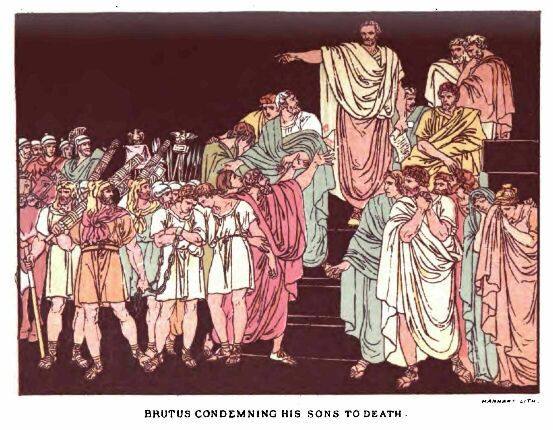
While they thought these things in their hearts there chanced to come ambassadors from King Tarquin. These made no mention of the matter whether the King should return, but asked only that his goods should be restored to him. To these the Senate gave audience; and when they had heard them were not a few days in debating the matter, for they said, "If we give not back these goods, there is open cause for war; and if we give them back, we minister means by which war may be carried on." In the meanwhile the ambassadors, making pretence to concern themselves only about the goods of the King, plotted in secret how they might bring him back. Going about therefore among the young nobles as if they would bespeak their favour on behalf of their errand, they made trial of what temper they were as to the bringing back of the King, and when they found that their words were not ill taken, they gave them certain tokens that they had brought from Tarquin, and had converse how the gates might be opened to him by night. And the matter was put in charge of certain noblemen, brothers, whose sister Brutus had to wife, and of this marriage there had been born to Brutus two sons that were now grown to manhood; and these young men had knowledge of the plot from the brethren of their mother. After a while the Senate passed a decree that the goods of the King should be given back to him; and the ambassadors made excuse to tarry yet longer, asking time of the Consul that they find waggons sufficient, to carry the goods. This time they spent wholly in consulting with them that were privy to the plot, being urgent with them that; they should give them a letter to carry to the King, "for," said they, "who will believe us if we bring not some written testimony in a matter so grave?" So the conspirators gave them a letter and thereby made manifest proof of their guilt. For a certain slave had conceived some suspicion of the matter, but waited for some more certain knowledge. Now it fell out that on the night before the day when the ambassador should depart there was a banquet at the house of them that had chief charge of the matter in Rome, at which banquet there was much talk, none being present but such as were privy to the plot. But the slave of whom mention has been made, having hidden himself, overheard that which was said; and when he knew that the letter had been given, he carried the matter straightway to the Consuls, who going laid hands on the ambassadors and on them that were privy to the plot, and so without uproar or violence brought the matter to an end. They that would have betrayed their country were thrown straightway into prison; as for the ambassadors, men doubted awhile how they should deal with them; but judged it better to send them away unhurt for all their misdoing. About the Kings goods counsel was taken anew; and the Senate decreed that neither should they be given back, nor should the price of them be brought into the treasury, but rather that the people should spoil them at their will. This having been done, the conspirators were brought to judgment, and being condemned, suffered death, being first beaten with rods and then beheaded. Now the Consuls' office was that, sitting in their seats, they should see sentence executed on evil doers. And this they did, nor did Brutus turn away from his duty, for all that his own sons were done to death before his eyes, but sat in his place, seeing that all things were done according to the law. As for the slave that bare witness against the conspirators, he had freedom and citizenship for his reward.
The end of Brutus was this. The men of Veii and the men of Tarquinii gathered together their armies and marched against Rome, that they might bring back King Tarquin. And the Romans came forth to meet them, Valerius having command of the foot soldiers and Brutus riding before with the horsemen. In the host of the enemy also the horsemen had the first place, their leaders being Aruns son of King Tarquin. And the lictors told Aruns, while they were yet far off, "See there is Brutus the Consul," who himself also, when the armies were now near together, knew the face of the man. Then he cried aloud in great wrath, "Lo, there is the man that hath driven us forth into banishment. See how proudly he goeth, bearing the honours that by good right are ours. Now may the gods that avenge the wrongs of kings be with me that I may slay him." So he struck spurs into his horse, and when Brutus saw that Aruns came against him he made haste to meet him. (In those days they that led armies into battle held it to be to their honour themselves to do battle.) And so full of fury were these two that neither took any thought how he might defend himself, but each smote the other through the body with his spear, so that they fell dying both of them from their horses.
After this there was fought a great battle, neither side having the victory, for when the men of Veii fled before the Romans, the men of Tarquinii prevailed against them that stood over against them. Nevertheless in the night a great panic fell upon the army of the Etrurians, so that they departed and went to their homes. Also they say that there was heard a voice from the grave of the hero Horatius, saying, "There fell in this battle more in number by one of the Etrurians than of the Romans; therefore the Romans are conquerors." When it was now day there was not a man of the Etrurians in his place; so Valerius the consul gathered together the spoil and returned in great triumph to Rome. Also he made a great burial for Brutus; and the people also mourned greatly for him, the women lamenting him for the space of a whole year, even as is the custom for women to lament for a father or a brother. And this they did because he had avenged the wrong done to a woman in so noble a fashion.
The Story of Coriolanus
It came to pass about the space of fifty years after the driving out of the kings that there arose great talk in Rome by reason of those that were in debt, their creditors dealing harshly with them. For the law was that if a man was in debt and had not wherewithal to pay, his creditor could cast him into prison and scourge him, dealing with him in all ways as with a slave. And when many of the people were already in this case, and many more feared lest they should be so hereafter, neither was there any hope of relief, because the rich men would not, for the most part, relax a right that was their due, they took counsel how they might best deliver themselves from this bondage. Now it chanced in a certain year that the army, having put to flight all their enemies, and being now returned to Rome, was bidden by the Consuls to set forth yet again to the battle, for the Consuls feared lest the men, being discharged from their service, should seek to make some change in the State. This bidding they were not willing to obey. First they doubted whether they should not slay the Consuls, thinking thus to be free from their oath; but, considering that a man cannot free himself from an oath by such ill-doing, they followed rather the counsel of a certain Sicinius, who bade them depart from Rome as though they would build them a city of their own. So they departed, marching to a certain place that men call the Sacred Hill, that is distant from the city about three miles, and is on the other side of the river Anio. There they made a camp with trench and rampart, and abode in this place many days, doing nothing either for good or evil. But when the nobles saw what had been done, they were in great fear what this thing might mean, but doubted not that Rome must be brought to destruction, unless the rich and the poor should be reconciled the one to the other. Therefore they sent a certain Menenius Agrippa, an eloquent man and dear to the Commons, as belonging to them by birth, who should be their spokesman. So Agrippa, coming to the camp and being admitted thereunto, spoke to the Commons this parable only; for in those days men were not wont to make set speeches. "In old times the members of man lived not together in such harmony as we now see to be among them; but each member had his own counsel and his own speech. All the other members therefore had great wrath against the belly, because that all things were gained for it by their care and labour and service, while it, remaining at rest in the midst of them all, did nought but enjoy the pleasures provided for it Wherefore they conspired that the hands should not carry food to the mouth, that the mouth should not take that which was offered to it, nor the teeth chew it. So it came to pass that while they would have subdued the belly by hunger, they themselves and the whole body were brought to great extremity of weakness. Then did it become manifest that the belly was not idle, but had also an office and service of its own, feeding others, even as itself was fed, seeing that it changed the food into that blood from which we have life and vigour, and so sent it back into all parts of the body. Consider then, and see how this wrath of the Commons against the nobles is as the wrath of the members against the belly." With these words he wrought upon the minds of the people so that they were willing to be reconciled, certain conditions being granted, whereof the chief was this, that the Commons should have officers of their own, tribunes by name, whom no man might harm under pain of death, and who should help the Commons, if need should arise, against the Consuls. Also it was provided that no noble should hold this office forever. Now it fell out not many days after these things that there arose a great famine in this land, so that the slaves and not a few of the Commons also had perished, but that the Consuls diligently gathered wheat from all places where it could be bought. And it came to pass that there was brought much wheat from the island of Sicily, and the Senators debated among themselves on what terms it should be given to the people. Now there were some among the nobles that took it very ill that the Commons should have officers of their own, by whose help they might stand against the Consuls, and the counsel of these was to use the occasion of this famine against them. The chiefest of these was a certain Marcius, that was surnamed Coriolanus.
How Marcius had won for himself this surname must now be told. The army of the Romans besieged Corioli, that was a town of the Volsci; and while they were busy with the siege, and thought only of the townsfolk that were shut in the town, there came upon them of a sudden an army of the Volscians from Antium, and at the same time the townsfolk sallied forth from the city. Now Marcius chanced to be on guard, and he, having a chosen band of soldiers with him, not only drave back them that had sallied forth, but entered into the city by the gate that was opened to receive them, slew them that were near, and set fire to such houses as were near to the walls. And when the townsfolk set up a shout, and the women and children cried out as is their wont in such alarm, the courage of the Romans was greatly increased, and the Volscians were troubled, thinking that the city to whose help they had come was already taken. Thus did Corioli come into possession of the Romans, and men gave to Marcius thereafter the surname of Coriolanus.
This Coriolanus therefore, being ill content that the Commons should have tribunes, spake in the Senate in this manner: "If the people will have such cheapness in corn as they had in old time, let them render back to the Fathers such rights as they also in old times possessed. Why should I see officers chosen from the multitude, and such a fellow as is this Sicinius bearing rule? Should I endure such disgrace longer than I needs must? If I would not endure King Tarquin, should I now endure King Sicinius? Let him call the Commons, if he will, to the Sacred Hill. The way thither—aye, and to other hills besides—is open if he would go. They have made this dearth for themselves, suffering their lands to be untilled; let them therefore enjoy what they have made."
This counsel seemed over harsh to the Senate; as for the Commons, it wrought them to madness. "See now," they cried, "how they would subdue us by hunger, even as though we were enemies! See how they would cheat us even of food! Lo! there is come this wheat from the stranger, which fortune has given us beyond all our hopes, and they would snatch it even from our mouths, unless, forsooth, we hand over our tribunes bound hand and foot to this Marcius, when they may work their will on the Commons of Rome with their scourges. What a savage is this that has risen up in our State, bidding us chose whether we will have slavery or death!" And as Coriolanus went forth from the senate-house they would have taken his life, but that the tribune named a day when he should stand his trial before the people. When they heard this their wrath abated, knowing that they had the power of life and death over their enemy.
Now at the first Coriolanus made light of the matter. "Who are these tribunes," he would say, "that they venture on such matters? Succour they may give to them that need it, but whence have they the power to punish? And are they not tribunes of the Commons and not of the nobles?" Notwithstanding, when the wrath of the people increased beyond all measure, the Fathers perceived that they must let one man suffer for all. For a while, indeed, they held their place, using all their power if haply they might prevail. First, they would set their followers about the city, who might prevent the Commons from holding assemblies, and so bring the matter to nought. After they came forth all of them, so that a man might have thought that all the Fathers were on their trial, using prayers and supplications for Coriolanus. "If ye will not acquit him of the charge, count him guilty indeed, but spare him for favour towards us."
When the day of trial was come, Coriolanus appeared not to answer, and the wrath of the people was still fierce against him. Being condemned, he was banished, and was to pass his exile among the Volscians, having even now in his heart the spirit of an enemy against Rome.
The Volscians, indeed, bade him welcome right heartily; and their goodwill towards him increased when they perceived what wrath he bore against his native country. His host was a certain Attius Tullus, than whom there was none among the Volscians either more powerful or more hostile to Rome. So the two held counsel together how they might stir up war. They knew, indeed, that the people could not easily be moved to that which they had tried so often with ill success. For their spirits were broken not only with many defeats which they had suffered in time past from the men of Rome, but also from pestilence, which had of late sorely troubled them. Nevertheless Attius had good hopes that he might yet kindle their anger against the Romans; and this indeed he accomplished, as shall now be told.
It chanced that in that year the great games at Rome were celebrated a second time; and the reason why they were celebrated a second time was this. On the day of the first celebration, early in the morning, a certain householder drave one of his slaves through the marketplace, beating him with rods. Afterwards the games began, and no man thought that aught was amiss. But no long time after a certain Atinius, a man of the people, dreamed a dream. He saw Jupiter, who spake to him saying, "I liked not him that danced the first dance at my Games. Unless they be celebrated again, and that right splendidly, there will be danger to the city. And do thou go and tell this to the Consuls." Now the man was not careless of the Gods, nevertheless because he stood in great fear of the Consuls he went not, lest he should be laughed to scorn for idle words. But this delay cost him dearly, for within a few days his son died. And that he might not doubt what this great trouble might mean, the god appeared to him yet again in a dream. "Hast thou had wages enough for thy neglect of that which I commanded? Verily, thou shalt receive yet more if thou tell not the matter straightway to the Consuls." Nevertheless, though the matter was now more urgent, yet the man delayed, and there fell upon him suddenly a great sickness and weakness. Thereupon he called his kinsfolk together to counsel, and told them all that he had seen and heard, how Jupiter had appeared to him in his dream, and had threatened him with punishment, and what had thereupon ensued When they heard these things, all with one consent agreed that the man should be carried straightway in a litter to the market-place into the presence of the Consuls. The Consuls commanded that he should be taken into the senate-house, where, being set down, he related all that had been told, to the great wonder of the Fathers. And when he had finished speaking, lo! there followed another marvel. His sickness departed from him in a moment, so that he that had been brought into the senate-house without power to move any limb, now, having fulfilled the command of the god, returned upon his feet to his own home.
The Senate, therefore, decreed that the Great Games should be celebrated a second time with great pomp. To this festival there came, at the bidding of Attius, a great company of the Volscians. But before the beginning of the games Attius, having agreed with Coriolanus what should be done, sought audience of the Consuls, saying that he would speak with them of a matter of great moment to the State. To them, none others being present, he said, "I like not to speak ill of my own countrymen. Yet seeing that I have not to accuse them of aught that they have done amiss, but rather to take care that they do it not, I will even speak my mind. The Volscians are of too light and fickle temper. From this cause we have already in time past suffered many things, so that in truth it is of your long-suffering rather than of our well-deserving that we are alive this day. Even now there is a great company of my people in this city; ye, men of Rome, will be wholly occupied with these games. Now I remember what on the like occasion was done in this place by certain young men of the Sabines, and I am in some fear lest the Volscians also should venture on a like misdeed. Of this, therefore, I give you warning, not for your sakes only, but also for ours. As for myself, it is my purpose to return straightway to my own home, lest something of the guilt of my countrymen should fall also upon me."
So Attius departed. And when the Consuls had brought the matter before the Senate, the Fathers, judging that they must take heed to that which had been told on such authority, commanded that all the Volscians should depart forthwith from the city. Thereupon criers were sent into all parts making proclamation, "Let every Volscian depart hence before nightfall." At the first, on the hearing of these words, as they hastened each man to his lodgings, to take up such things as belonged to him, there was great fear; and afterwards, when they were now setting out on their journey, not the less anger. "What is this," said they, "that we are driven forth from the presence of gods and men on a day of festival as if we were polluted with crime?" Now Attius had gone before them to the Fountain of Ferentina; and as each of the chief men of the State came thither he spake with him about this matter, making loud complaints and much display of wrath. And the chiefs gathered the people together to an assembly in the plain ground that is beneath the road. To whom Tullus spake, saying, "Though ye forget, ye Volscians, all the wrong that the Romans have done to us in old times and all that we have suffered at their hands, how will ye bear the scorn that hath been put upon you this day, when they have begun their games by making sport of us? Do ye not perceive that when ye departed in this fashion ye were made a spectacle to citizens and strangers and all the nations round about? What thought they that heard the voice of the crier? or they that saw you depart? or they that met you as ye came hither in such unseemly plight? What but this, that ye had done some great wickedness, wherefore ye must be driven away from the gathering of gods and men lest your presence should be a defilement? Is not this a city of enemies, wherein if ye had tarried but one single day ye would all have suffered death? They have declared war against you, and if ye are men they will suffer no small loss therefrom."
Thus it was brought to pass that all the Volscians joined together to make war against Rome. First they chose for leaders Attius and Coriolanus, in whom indeed they trusted the more of the two. And indeed they trusted rightly, as was proved in the end, so that it became manifest that Rome had prevailed rather through the skilfulness of leaders than the courage of armies. First Coriolanus came to Circeii, that is hard by the sea, and drave out thence the Roman colonists, and gave over the city to the Romans. After this he took many cities of the Latins, and at the last pitched his camp five miles from Rome, sending out thence those who might spoil the lands of the Romans. Only he gave commandment that they should not spoil the lands of the nobles. And this he did, either because he hated the Commons more than the nobles, or that he would sow dissension between the two. This, indeed, he did not, for a common fear bound them together. Yet there was so much of disagreement that the nobles would have had recourse to war to rid them of the enemy, but the Commons were urgent that they should rather seek for conditions of peace. And this opinion prevailed. Ambassadors therefore were sent to Coriolanus, to whom he gave this answer only: "When ye shall have given back all their lands to the Volscians, then may ye talk of peace. But if ye seek to enjoy in peace that which ye took for yourselves by war, ye shall see that I forget neither what wrong I suffered from my own people, nor what kindness I have received from my hosts." And when the ambassadors were sent a second time he would not suffer them to enter the camp. After them came the priests, bearing the emblems of their office; nor did these prevail more than the ambassadors. Then a great company of the women came to Veturia, the mother of Coriolanus, and to Volumnia, that was his wife. But whether they did this by consent of the rulers, or by prompting of their own fear, cannot be affirmed for certain. These women then prevailed with Veturia, though she was now well stricken in years, and with Volumnia, that they should go to the camp to Coriolanus; and Volumnia carried with her the two sons that she had borne to Coriolanus. These having come, it was told the man that a great company of women was arrived. At the first, indeed, he was not minded to yield to their tears that which he had steadfastly refused to the ambassadors. But afterwards, when a certain one of his friends, seeing Veturia stand together with her daughter-inlaw and grandsons, said, "Unless my eyes deceive me, thy mother and wife and children are here." Coriolanus, being greatly troubled, leapt from his seat and would have embraced his mother. But she, turning from supplication to anger, cried, "I would fain know, before I receive thy embrace, whether I see a son or an enemy before me, whether I am thy mother or a prisoner. Has long life been given me for this, that I should see thee first an exile and afterwards an enemy? Couldst thou bear to lay waste this land which gave thee birth and nurture? Didst thou not think to thyself, seeing Rome, 'Within those walls are my home, my mother, my wife, my children'? As for me I cannot suffer more than I have already endured; nor doth there yet remain to me a long space of life or of misery. But consider these thy children. If thou art steadfast to work thy will, they must either die before their time or grow old in bondage."
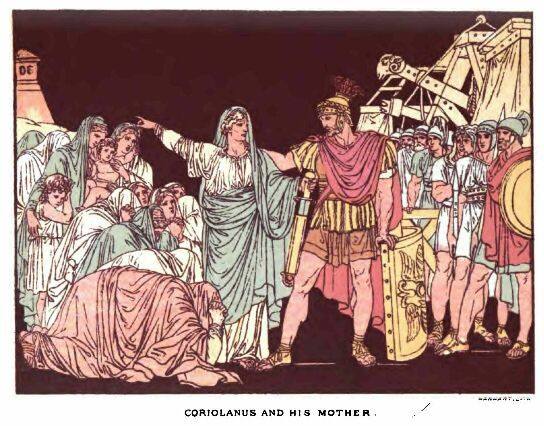
When she had ended these words, his wife and his children embraced him; and at the same time the whole company of women set up a great wailing. Thus was the purpose of Coriolanus against his country changed, and, breaking up his camp, he led his army away. Some say that the Volscians slew him for wrath that he let slip this occasion against Rome; but others relate that he lived to old age, being wont to say, "There is no man so unhappy as he that is old and also an exile."
The Story of Cincinnatus
In the seventy and third year after the driving out of the kings the strife between the nobles and the Commons grew to be fierce beyond measure; for on the one hand the Consuls would have levied an army to make war with the Volscians, and this the tribunes hindered; and on the other hand the tribunes sought to establish a law that should set bounds to the power of the Consuls, and this law the nobles hindered that it should not be passed. Now among the nobles (who were mostly of the younger sort, for the elders held aloof from the matter) the chief mover was one Kæso Quinctius, a youth of singular strength and courage, and that had won for himself great renown in war. This man was wont to drive the tribunes from the market-place and scatter the people, and when Virginius, that was one of the tribunes, named a day on which he should be brought to judgment for his misdeeds, he was not one whit dismayed, but bare himself as haughtily as before. Meanwhile Virginius stirred up the people, saying, "See ye not, men of Rome, that if ye suffer this Kæso to dwell in this city, it cannot be that this law which ye desire should be established? But why speak I of laws? This man is the enemy of liberty itself; not King Tarquin himself was so haughty and violent. He is a very king already; what think ye will he be if he be made consul or dictator?" To these words many gave assent, complaining that Kæso had beaten them, and were urgent with the tribune that he should carry the matter to an end. Then it came to pass that, when the day of trial was come, the people were of one mind that Kæso should be condemned. Then, indeed, the young man and his kinsfolk and friends turned to supplications and prayers. Titus Quinctius, that had been three times consul, affirmed, "Never in the home of Quinctius, never verily in this city of Rome, has there been a soldier of so ripe a courage. When I was captain of the host, he was ever the first; with these eyes have I seen him fighting against the enemy." Also Lucretius, that had been consul the year before, winning great glory from the Volscians and Æquians, testified that Kæso had helped him to conquer as none other had done; and one Furius that he had delivered him and his army from great peril of defeat As for Lucius Quinctius, his father, whose surname was Cincinnatus, he sought not to magnify the valour and brave deeds of his son, lest haply he should so stir up the more jealousy against him, but sought to make excuse for him, as one who had erred for want of discretion, beseeching men that, if he himself had wronged no man by word or deed, so they would grant him for a favour the pardon of his son. But nothing availed with the people, some fearing the wrath of their fellows if they should give ear to such words, and some making complaint that they had suffered violence from the hands of Kæso, and affirming that they would be avenged of him for his misdeeds. Now of all things that were alleged against him the most grievous was the accusation brought by a certain Volscius that had once been tribune of the Commons; for Volscius bare this witness against him: "Not many days after the plague had ceased from the city, I, with others in my company, fell in with certain young men, of whom this Kæso was one, disporting themselves in the street. These fell out with us, and Kæso smote my elder brother with the fist, so that he fell fainting to the ground, being then not wholly recovered from the plague. And being carried home, he died by noon, as I doubt not, of this blow. But when I would have brought Kæso to judgment for this offence, the Consuls would not suffer it." At the hearing of this tale the wrath of the Commons waxed so hot that they could scarcely be kept from falling on Kæso and slaying him. At the last, after much debate between the nobles and the tribunes, it was agreed that the young man should appear the next day to make his answer to these accusations, giving sureties in the meanwhile lest he should fail to do so. Ten sureties he gave, and each was bound in three thousand pounds of copper. So being suffered to depart from the market-place, he departed that same night from Rome, going into banishment among the Etrurians. As for his sureties, the money was exacted from his father to the uttermost farthing, so that he was compelled to sell all his goods, and to dwell in a mean cottage on the other side of the Tiber.
It came to pass in the third year after these things that the Æquians brake the treaty of peace which they had made with Rome, and, taking one Gracchus Cloelius for their leader, marched into the land of Tusculum; and when they had plundered the country thereabouts, and had gathered together much booty, they pitched their camp on Mount Ægidus. To them the Romans sent three ambassadors, who should complain of the wrong done, and seek redress. But when they would have fulfilled their errand, Gracchus the Æquian spake, saying, "If ye have any message from the Senate of Rome, tell it to this oak, for I have other business to do;" for it chanced that there was a great oak that stood hard by, and made a shadow over the general's tent. Then one of the ambassadors, as he turned to depart, made reply, "Yes, let this sacred oak and all the gods that are in heaven hear how ye have wrongfully broken the treaty of peace; and let them that hear help us also in the day of battle, when we shall avenge on you the laws both of gods and of men that ye have set at nought."
When the ambassadors had returned to Rome the Senate commanded that there should be levied two armies; and that Minucius the consul should march with the one against the Æquians on Mount Ægidus, and that the other should hinder the enemy from their plundering. This levying the tribunes of the Commons sought to hinder; and perchance had done so, but there also came well-nigh to the walls of the city a great host of the Sabines plundering all the country. Thereupon the people willingly offered themselves, and there were levied forthwith two great armies. Nevertheless when the consul Minucius had marched to Mount Ægidus, and had pitched his camp not far from the Æquians, he did nought for fear of the enemy, but kept himself within his entrenchments. And when the enemy perceived that he was afraid, growing the bolder for his lack of courage, they drew lines about him, keeping him in on every side. Yet before that he was altogether shut up there escaped from his camp five horsemen, that bare tidings to Rome how that the Consul, together with his army, was besieged. The people were sorely dismayed to hear such tidings; nor, when they cast about for help, saw they any man that might be sufficient for such peril, save only Cincinnatus. By common consent, therefore, he was made Dictator for six months, a thing that may well be noted by those who hold that nothing is to be accounted of in comparison of riches, and that no man may win great honour or show forth singular virtue unless he be well furnished with wealth. For here in this great peril of the Roman people there was no hope of safety but in one who was cultivating with his own hand a little plot of scarcely three acres of ground. For when the messengers of the people came to him they found him ploughing, or, as some say, digging a ditch. When they had greeted each the other, the messengers said, "May the Gods prosper this thing to the Roman people and to thee. Put on thy robe and hear the words of the people."
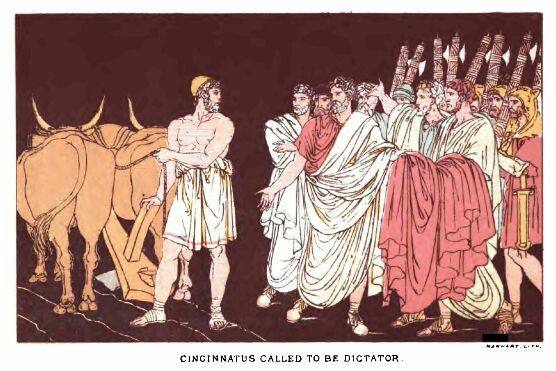
Then said Cincinnatus, being not a little astonished, "Is all well?" and at the same time he called to his wife Racilia that she should bring forth his robe from the cottage. So she brought it forth, and the man wiped from him the dust and the sweat, and clad himself in his robe, and stood before the messengers. These said to him, "The people of Rome make thee Dictator, and bid thee come forthwith to the city." And at the same time they told how the Consul and his army were besieged by the Æquians. So Cincinnatus departed to Rome; and when he came to the other side of the Tiber there met him first his three sons, and next many of his kinsfolk and friends, and after them a numerous company of the nobles. These all conducted him to his house, the lictors, four and twenty in number, marching before him. There was also assembled a very great concourse of the people, fearing much how the Dictator might deal with them, for they knew what manner of man he was, and that there was no limit to his power, nor any appeal from him.
The next day before dawn the Dictator came into the market-place, and appointed one Lucius Tarquinius to be Master of the Horse. This Tarquinius was held by common consent to excel all other men in exercises of war; only, though, being a noble by birth, he should have been among the horsemen, he had served, for lack of means, as a foot soldier. This done he called an assembly of the people and commanded that all the shops in the city should be shut; that no man should concern himself with any private business, but all that were of an age to go to the war should be present before sunset in the Field of Mars, each man having with him provisions of cooked food for five days, and twelve stakes. As for them that were past the age, they should prepare the food while the young men made ready their arms and sought for the stakes. These last they took as they found them, no man hindering them; and when the time appointed by the Dictator was come, all were assembled, ready, as occasion might serve, either to march or to give battle. Forthwith they set out, the Dictator leading the foot soldiers by their legions, and Tarquinius the horsemen, and each bidding them that followed make all haste. "We must needs come," they said, "to our journey's end while it is yet night. Remember that the Consul and his army have been besieged now for three days, and that no man knows what a day or a night may bring forth." The soldiers themselves also were zealous to obey, crying out to the standard-bearers that they should quicken their steps, and to their fellows that they should not lag behind. Thus they came at midnight to Mount Ægidus, and when they perceived that the enemy was at hand they halted the standards. Then the Consul rode forward to see, so far as the darkness would suffer him, how great was the camp of the Æquians and after what fashion it was pitched. This done he commanded that the baggage should be gathered together into a heap, and that the soldiers should stand every man in his own place. After this he compassed about the whole army of the enemy with his own army, and commanded that at a set signal every man should shout, and when they had shouted should dig a trench and set up therein the stakes. This the soldiers did, and the noise of the shouting passed over the camp of the enemy and came into the city, causing therein great joy, even as it caused great fear in the camp. For the Romans cried, "These be our countrymen, and they bring us help." Then said the Consul, "We must make no delay. By that shout is signified, not that they are come only, but that they are already dealing with the enemy. Doubtless the camp of the Æquians is even now assailed from without. Take ye your arms and follow me." So the legion went forth, it being yet night, to the battle, and as they went they shouted, that the Dictator might be aware. Now the Æquians had set themselves to hinder the making of a ditch and rampart which should shut them in; but when the Romans from the camp fell upon them, fearing lest these should make their way through the midst of their camp, they left them that were with Cincinnatus to finish their entrenching, and fought with the Consul. And when it was now light, lo! they were already shut in, and the Romans, having finished their entrenching, began to trouble them. And when the Æquians perceived that the battle was now on either side of them, they could withstand no longer, but sent ambassadors praying for peace, and saying, "Ye have prevailed; slay us not, but rather permit us to depart, leaving our arms behind us." Then said the Dictator, "I care not to have the blood of the Æquians. Ye may depart, but ye shall depart passing under the yoke, that ye may thus acknowledge to all men that ye are indeed vanquished." Now the yoke is thus made. There are set up in the ground two spears, and over them is bound by ropes a third spear. So the Æquians passed under the yoke.
In the camp of the enemy there was found abundance of spoil. This the Dictator gave wholly to his own soldiers. "Ye were well-nigh a spoil to the enemy," said he to the army of the Consul, "therefore ye shall have no share in the spoiling of them. As for thee, Minucius, be thou a lieutenant only till thou hast learnt how to bear thyself as a consul." Meanwhile at Rome there was held a meeting of the Senate, at which it was commanded that Cincinnatus should enter the city in triumph, his soldiers following him in order of march.
Before his chariot there were led the generals of the enemy; also the standards were carried in the front; and after these came the army, every man laden with spoil. That day there was great rejoicing in the city, every man setting forth a banquet before his doors in the street.
After this, Volscius, that had borne false witness against Kæso, was found guilty of perjury, and went into exile. And when Cincinnatus saw that justice had been done to this evil-doer, he resigned his dictatorship, having held it for sixteen days only.
The Story of Camillus
In the next year the Senate would have sent a colony into the country of the Volscians, giving to each man two acres of land and more. But the thing pleased not the Commons, who said, "Why do ye send us into exile in the land of the Volscians while this fair city of Veii lieth within view, having lands both wider and more fertile than are the lands of Rome?" The city also they preferred to their own, both for its situation and for the magnificence of its buildings both public and private. Their counsel, therefore, was that the State should be divided, and that the nobles should dwell at Rome and the Commons at Veii. But the nobles steadfastly withstood it, saying, "We will die rather than that such a thing be done. If there be such trouble in one city, how much more, think ye, will there be in two? Will ye prefer a city that is vanquished to that which is victorious? Will ye leave Romulus, your founder, a god and the son of a god, and follow Sicinius?" (This Sicinius was tribune of the Commons and had brought this matter forward.)
None was more urgent against this counsel than Camillus. "Verily," he would say, "there is nothing at which to marvel in these troubles. The whole state is mad, for, though it is bound by a vow, it careth for every matter rather than how this vow may best be paid. Of that which was paid for the tenth, verily a small part in place of the whole, I say nothing. This toucheth the consciences of all, but the state is free. But there is another matter of which I dare not be silent any more. We have set apart a tenth of those things which were moveable. Of the city and of the lands ye make no mention, yet were these comprehended in the vow." This matter the Senate referred to the priests, and the priests, having called Camillus into council, gave this sentence: "There is due to Apollo a tenth of all that before the uttering of the vow belonged to the men of Veii, and afterwards came into the power of the Roman people." Thus the city and the lands thereof were included. The money, therefore, was paid out of the public treasury; and the magistrates were commanded to purchase gold therewith. And when there was not found a sufficient quantity of this metal, the matrons, having first met and deliberated on the matter, promised that they would themselves supply the magistrates with gold, and carried all their ornaments to the treasury.
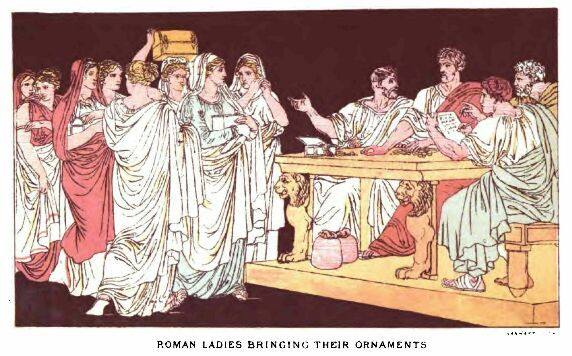
Never was anything done that more pleased the Senate than this liberality of the women; and, by way of recompense, it was ordered that they should thereafter enjoy this privilege, that they should use covered chariots whensoever they went to public worship or to the games, and other carriages on any day, whether festival or common. Notwithstanding, the tribunes of the Commons were still bitter against Camillus. "Verily," they said, "by his confiscations and consecrations he hath brought the spoil of Veii to nothing."
The next year there was war with the men of Falerii. These at the first, for fear of the Romans, kept themselves within their walls; but afterwards, not enduring to see the plundering of their lands, came forth, and pitched their camp about the space of a mile from the town, in a steep and difficult place. But Camillus, for he was the captain of the host, taking for his guide a man of those parts that had been made prisoner, left his place by night, and showed himself in the morning on ground higher by far. And when the enemy assailed him, as he was fortifying his camp, he put them to flight, putting them into such fear that they left their camp and fled to the city, but suffered much loss of slain and wounded before they could arrive at the gates.
The town was now shut up; but because they that were besieged had better supply of corn and other things needful than they that besieged, the matter might have been delayed no less than was the taking of Veii, but for the good fortune and virtue of Camillus.
It was the custom among the men of Falerii to use the same person for teachers of their children and also for their companions. Also, according to the Greek fashion, many boys would be taught by the same man. Now the children of the chief citizens of the place were in the charge of a certain teacher, that had the repute of excelling all others in knowledge. This man had been wont in time of peace to lead the boys out of the city for the sake of exercise and sport; and this custom he had not ceased even after the beginning of the war, but would take them away from the gates at one time in longer at another in shorter journeys. At length he took occasion to lead them farther than before, and to bring them, occupying them meanwhile with sport and talk, as far as the camp of the Romans. Taking them therefore to the tent of Camillus, he said, "I have delivered Falerii into your hands, for these boys that ye see are the children of the chief men of the city." To this Camillus made answer, "Neither the general nor the people to whom thou comest bringing this wicked gift is like unto thyself. With the men of Falerii we have not indeed friendship, yet we have with them as with all men a natural fellowship. War also has laws even as peace, and to these laws we have learnt obedience, even as we have learned courage. Our arms we carry not against lads of tender age, who are not harmed even in the storming of cities, but against men that carry arms in their hands. These I shall conquer, even as I conquered Veii, in Roman fashion, even by valour, by labour, and by arms."
When he had so spoken he commanded that the man should be stripped of his clothing, and that his hands should be tied behind his back. In this plight he delivered him to the lads to be taken back to the city, giving them rods wherewith to scourge the traitor, and drive him back to Falerii. There was a great concourse of people to see this sight; and the Senate was summoned by the magistrates to consider the matter. So great a change was wrought in the minds of men that they who a little before had been obstinate to perish like the men of Veii, now with one voice desired peace. Ambassadors therefore were sent to Camillus, who, having been bidden by him to go to Rome, had audience of the Senate, to whom they spake thus: "Fathers, ye and your generals have overcome us in such a fashion as neither gods nor men can blame. We therefore surrender ourselves to you, making no doubt that we shall live more happily under your government than under our own laws." Peace was granted to them on the condition that they should bring the tax for that year, that the burden of the Commons might be eased.
After this the Senate sent three messengers to Delphi bearing with them the offering of the Roman people to the god, namely, a mixing-bowl of gold. These messsengers were taken by pirates of Lipara and carried to that town. Now the custom at Lipara was that plunder so taken was divided among the people. But the chief magistrate of Lipara for that year, having a reverence for the character of ambassadors, and considering also that they were carrying an offering to the god, and knowing for what cause this offering was made, persuaded the multitude also. The messengers, therefore, were entertained at the public expense, and having been sent with a convoy of ships to Greece, were so brought back safe to the city of Rome.
In the fourth year after these things, one Marcus Cædicius, a man of the Commons, gave information to the magistrates that in the new street above the temple of Vesta he had heard a voice louder than the voice of man, that said these words, "The Gauls are coming." No heed was taken of this thing, both because the man that told it was of little account, and because the nation of the Gauls, dwelling far off, was little known.
Not only did the people of Rome despise the warnings of the gods, but also they deprived themselves, as far as in them lay, of all human help, driving away Camillus from their city. For, having been summoned to stand his trial by one of the tribunes of the Commons in the matter of the spoil of Veii (and it had chanced also that in those same days he had suffered the loss of a son that was almost grown to years of manhood), he called together to his house the members of his tribe and his dependants, being themselves no small part of the Commons, and laid the matter before them. And when they had answered him that they would contribute among themselves whatsoever fine he might be condemned to pay, but that they could not bring it about that he should be acquitted, he went into exile, first putting up to the immortal gods this prayer. "If I am not deserving of this wrong, cause, I beseech you, that this people may repent them that they have driven me forth." Being absent on the day of trial he was condemned to pay fifteen thousand pounds' weight of copper.