 Curio Class
Maori Legends (set)
W. Dittmer
Tiki, the Ancestor of Mankind
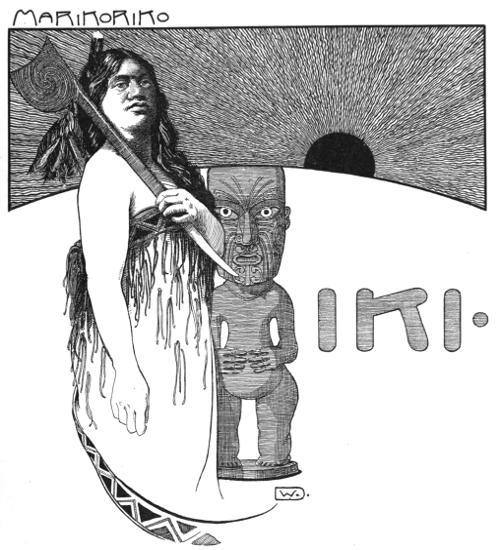
Marikoriko, the first woman, and Tiki, her Creator.
Hupene, the old Tohunga, squats muttering on the floor beside his carved ancestor Tiki.
Tiki is a god who in the dim long ago helped to build the world, and whose carved image is now supporting the middle pillar of the house. His eyes of pawa-shell, which once commanded in the ten Heavens and were full of fire and wisdom, glisten out of the silent twilight; they stare far, far into the darkness, which Hine-nui-te-po is slowly spreading over the world, Hine-nui-te-po, the Great Mother of Night, who at one time was young and beautiful, and gave life to Nature.
“Haere-mai, e te manuhire, Haere-mai” (“Welcome, stranger, welcome”), so speaks the old Tohunga; then, drawing his flax mat around him, he mutters: “Haere-mai”, and, after a long silence again, as if murmuring to himself, “Haere-mai”—but soon his eyes follow those of his ancestor again, gazing into the silence of the slowly descending night, the ancient goddess Hine-nui-te-po, the Great Mother of Rest. Wisdom dwells with the aged, and their muttering is the sign that their wisdom is ripe. Flying from the mouth of the old it becomes mother now and wife to the listening ear.
“Listen, my guest:
When man dies, he returns no more to the place which once knew him. Unlike the Daughter of Heaven, Te marama, the moon, which ever ascends to new life from the Spring of Living Water, man must die: he is devoured by Hine-nui-te-po, the Great Mother of Nature, the first among the gods; and man is her food.
Ha, hear now the story of Tiki, our Father, the Father of man!
When Rangi-nui, the great Heaven, and Papa-tu-a-nuku, the far-stretching earth, were separated from each other, then, my listener, the light shone over Papa-tu-a-nuku, the mother of Tiki, and he was the first man.
Ah, great was his longing for the power to spread himself out over Papa: father of mankind he wanted to be! Far, and far, and far he wandered over Hawaiki, searching and asking, and again and again he wandered forth over all Hawaiki, his heart full of longing.
Ah, my listener, full of longing was his heart.
At last he came to the river at Hawaiki known by the name of Wai-matu-hirangi, and from the depth of his desire he cried aloud: ‘Oh, daughter of Hawaiki, child of the murmuring water, tell me how I may become the father of mankind. Tell me where may I obtain the power and from whom?’
And the river Wai-matu-hirangi answered him and said: ‘Ha, Tiki, son of Heaven and Earth, go and search for the incantations and the powerful Karakias to the gods who have the desires of man in their keeping, and when you have obtained them return to me here, for it is here that the child of man shall be born: out of the murmuring waters at Hawaiki. Go, and search!’
O, listen to Tiki, our father, the father of man.
Ha!—see how he set out on his search. First he journeyed to the gods of Te Po, the Lower World, and then he made his toilsome way through the ten heavens, searching for the sacred incantations and the Karakias, the object of his mighty quest, and at last, high, high in the uppermost heaven, he found them—ah, my listener!
Joy made his journey light and the distance easy, and it was with a gladsome heart that he stood once more by the river in Hawaiki and cried aloud:
‘Oh, Daughter of the Many Faces, I bring with me the Karakias to the powerful gods, the great incantations which will give power and ecstasy to Tiki. See, I bring the incantations for which I went in search.’
Then he knelt down, and, as the gods had commanded him, mixed the sacred red colour with the soft sands of the shore, and formed a figure like unto himself, as he saw his own image reflected in the water. Full of joy, he shaped the body and the limbs, the head and the eyes; and then he commenced to chant the sacred incantation, the first lines of which are as follows:
‘From the children at Hawaiki,
Shake in ecstasies
Oh, shake in ecstasies
Oh, Tiki, the Father,
Tiki, the Seeker,
Ha, shake in ecstasies....’
And so, with the help of the Shimmering Heat and the Echo, the power of multiplying, he gave life to the first woman.
Marikoriko, or Twilight, was the first woman!
Marikoriko, my listener, was not a child of the gods; she was created out of the sands of the shore and the sacred Red; she takes her descent from the Shimmering Heat and from the Echo, and she became the first wife of Tiki, our father.
Many children were born to Tiki and Marikoriko his wife. Their daughter was Hine-kau-ata-ata, the Floating Shadow. And the children of Hine-kau-ata-ata began their lives as clouds, wandering across the sky. They were light, and flew far away till lost to sight in the distance, or they were heavy and did not move and brooded overhead in rain. Then it was that Papa-tu-a-nuku, the Earth, lay under the spell of the first awakening day.
Among the many children of Tiki and Marikoriko were the sons the Power of Speech and the Power of Growth, who took their sisters to wife, and Te-a-io-whaka-tangata, ‘He who became man’, was born, and he was the father of many children—the Maori children of the world.
This is the wisdom of Tiki, our father, and Marikoriko his wife, the parents of man who peoples the earth. The wisdom of Tiki, our father.
Welcome my guest from the far distance, welcome!
You give pleasure to my eyes, and in your ears has sounded the wisdom of Tiki.—Welcome, friends of my guest.
Welcome all!
Welcome!”
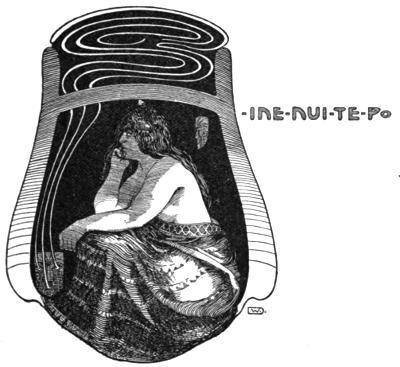
Hine-nui-te-po has swallowed the world again and Rangi looks down upon Papa out of his Eye of Night, the moon, and is slowly unfolding his beautiful garment, which is adorned with the stars—the eyes of the braves who fell in battle.
Fiery looks Maru down upon the women who kindle the cooking-fire; Maru was the god of war in Hawaiki, but he was an evil god, full of anger and wrath, and from him are descended illness and murder. He had many enemies, and at last they killed him, and devoured him; but his spirit flew up to Rangi, there to become the fiery and flashing star.
Rauriki, the oldest among the women who kindle the cooking-fire, murmurs, for she is old, but she is a woman and murmurs no wisdom; she murmurs incantations to the fire that it might listen to Maui, who once brought the fire into the world—to be bright and warm and to cook the food for the hungry and for the guest.
Silent and peaceful is the night. The Great Mother of Nature swallows silently a few old songs and the low-toned voices that sound out of the huts and the whare-puni.
Ngawai, Rauriki’s granddaughter now takes the embers to the whare-puni, and puts them to the feet of Tiki, to warm and light the house, and outside Night is working her grand and lonely wonders, while the old men, squatting around the fire and staring into the flames, narrate of the terrors of Hine-nui-te-po.
Musing and wondering thoughts light up the glow of the fire in the faces, fire flashes out of the pawa-shell eyes of the old ancestor, and patches of light flicker over the group that surrounds the fire, now lighting up the artistic lines of the tattoo in the faces, now again the phantastic carvings on the walls, or suddenly brightening a painted ornament, and covering the rest with impenetrable blackness.
Every line the light reveals, every colour it displays, gives knowledge: each carved image is a part of the history of the people. It is the family history of the group around the fire, their history painted by the god of the fire upon the black garment of night—and with the fire it will die, swallowed by Hine-nui-te-po. And so in the end all will die, the words, and the speaker, and the listener: they all will at last be devoured by Hine-nui-te-po, who has brought forth Rangi and Papa, who has brought forth Tiki, who made Marikoriko his wife.
Out of the womb of Hine-nui-te-po came the world, and to her all must go back—as the fire to the ashes.
The Creation of the Stars
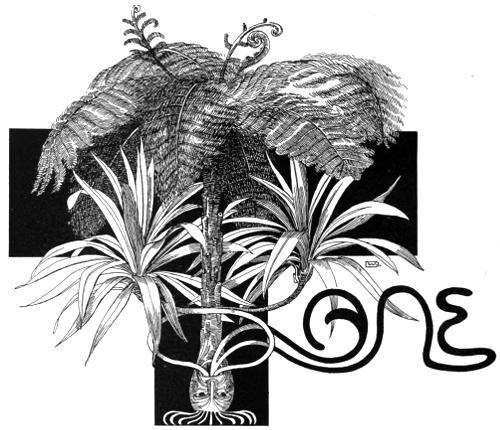
Te Ra, the day-eye of Rangi is closing, and sends a last glowing look over the peacefully dreaming Moana-rarapa, the Lake of the Glittering Water.
Softly murmurs the lake and reflects the sacred Red with which Tane once adorned the heaven, whilst over his floating colours black swans are drifting like dream-thoughts over a beautiful face. Slowly dying away in blue, deep blue and pure, is the last breath of day silently departing into the heavens.
A canoe is putting off the shore, and voices of children are heard leading it light-hearted with mirth and laughter and splashing of water over the lake, which looks clear and glittering green up to the stars. Softly now breathes the air, and the mirror is gone—the day has departed.
Muttering departs Hupene, our old friend, in dread of the darkness; with his mat he is covering our shoulders and he murmurs these words:
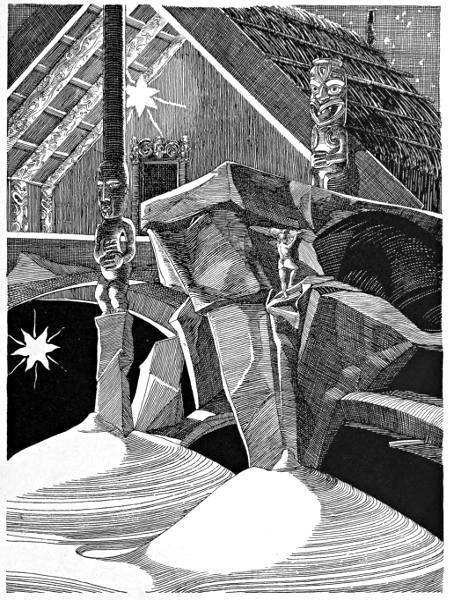
TANE SEARCHING FOR THE DWELLING OF THE EVENING STAR AND THE MORNING STAR
“Remember, while you are watching the stars on the night-mat of Rangi, and know, great is the power of the god Tane-Mahuta, and his are the stars.
Remember, his are the stars.”—
Bright shimmer the stars through the summer night, and the earth breathes freshness and sleep, leading the heart to rest, and it yet filling with longing; but from the heaven descends hope, promising the new day and the future.
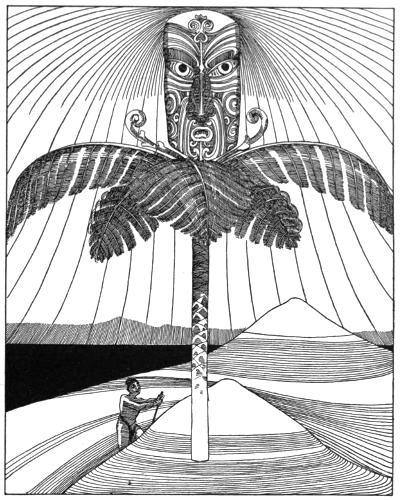
Tane once commenced his great wandering to find adornment for his father, the heaven, whom he beheld standing high over Papa, naked by day and lonely and cold by night, and he spoke:
“O, father Rangi, my heart is looking upon you in sorrow, for you are lonely and cold, and I will go in quest for adornments which shall make you beautiful to the eyes of Papa and her children.” Thereupon he went on his way, and, whilst he was wandering through the ten heavens, he found Te-Kura, the Red Colour, and that he took back with him upon the earth. Here he rested for seven days and seven nights, and, when his strength was growing again, he commenced his work, and covered the heaven with the beautiful red colour. But behold, when he had finished this great work and descended again to earth, he let his eyes wander over the red sky, which was stretching now over Papa, and he found that this adornment was not worthy of his great father, and full of sorrow he took it away again leaving some of it only at Mahiku-rangi, the End of Heaven. He beheld now, when Rangi was closing his great eye, sending it down into the Po, or when he called for it again in the mornings so that it burst forth out of the Gate of Day, that the beauty of his father at Mahiku-Rangi was wonderful, but ever and ever it disappeared by day and by night.
Seven days and seven nights he was watching the dying away and bursting forth again of Rangi’s beauty, and then out of his sorrow he sang these words up to his father: “Oh, Rangi, still you are cold and dark and lonely from the first night, to the second night, to the tenth night, when your daughter Te-marama ascends again out of the Source of Living Water, so that you look down upon Papa silent and sorrowful. What adornment can I find for you, that you may be happy and beautiful, and gladden the heart of Papa, your loved one?”
After he had spoken these words he wandered forth again upon his mighty search, and all over the world he wandered, and farther and farther still he wandered, till he came to Tawhiti-nui, the Great Distance; and farther still, till at last he came to Te-Po, the Lower World. Here he found Hine-a-te-ao, the Daughter of the Light; she is the guardian of the Gates of the Lower World, and, tired from his long journey, he slept in her house.
In the darkness of night he beheld two beautiful stars shining forth; they were the children of Ira, and their names were Lonely South, and Shore of Heaven, the morning star, and his heart was glad over their beauty, so that his eyes could not sleep, and could not but rest upon them all the night.
In the morning he called Hine-a-te-ao, and showed her the two beautiful stars shimmering forth out of the darkness of the Po, and asked for them, for nothing could be more beautiful he thought as an adornment for his Father Rangi. Hine-a-te-ao answered: “Go, son, and take the stars!” And again he pleaded: “Oh, Hine, Daughter of the Light, show me the road that I may go and take the stars.” And Hine-a-te-ao answered: “O, son, far is the way indeed! Go to the House of Tupu-renga-o-te-Po, the Growing Night: he is the guardian over the two stars, and his house is standing at Mahiku-rangi. There ask for the two stars, whose names are Toko-meha and Te-pae-tai-o-te-rangi; go and take the stars for your father Rangi.”
After Tane had rested, and for seven days and seven nights strengthened himself through powerful incantations and many Karakias, he went on his way to Mahiku-rangi, to the House of the Guardian of the Stars, Tupu.
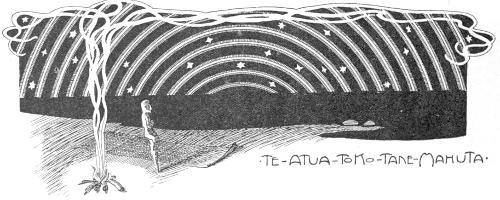
When at last he had found Tupu, he pictured the sorrows and the nakedness of his father, and asked him to give the beautiful stars to Rangi, and Tupu answered: “Oh, Tane, son of Rangi and Papa, the stars which you behold shimmering yonder are the sacred holders of the world; they are Hira-utu, Fish by the Land, Hira-tai, Fish of the Sea; Parinuku, Cliff by the Earth, and Pari-rangi, Cliff of the Heavens. Yes, it is my wish that you may adorn Rangi with yonder stars.” And he gave him the Four Sacred Holders of the World, the stars of the four points of the compass, and then he gave him the five stars, Ao-tahi, Puaka and Tuku-rua, Tama-re-reti and Te-waka-a-tama-rereti.
All these stars Tane took away with him and fastened the four sacred stars in the four corners of Rangi; with the other five he formed a cross in the South.
Many more stars brought Tupu, and Tane distributed them over Rangi from the summit of the mountains whilst still the Sun was standing high in the heavens.
And again sorrow filled his heart when his eyes looked upon his work, for again he found that the adornment was not worthy of his father Rangi.
But at last he had finished his labour and that was about the time when the Sun was again entering the Gate of Night. Resting upon Papa, he watched the beautiful sacred red appear again at Mahiku-rangi, and, when with the departing sun darkness again filled the world, his wandering eyes perceived how star upon star commenced to live and shine forth, till at last Rangi in wonderful beauty was stretching over Papa, and his heart was full of joy and happiness, and he sang: “O, father Rangi, your beauty is indescribable; in truth you are now the ariki of Papa, and all her children will love you!”
Thus had spoken the old friend on the shores of the glittering Moana-rarapa.
Maui and the Creation of New Zealand
A MAUI Over the sky shoot the first golden rays of the Sun whilst our canoe is gliding up-river and Honewaka is singing:
“Who is paddling my canoe along the river?
It is Hine, who takes my heart away from me!
O Rangi, send down thy dark clouds of rain,
That my dear love may not depart from me!—
O, I wish the water were heaped into waves
So my dear one will not go in haste from me.”
Honewaka is leader; standing in the middle of the canoe, in his hand the greenstone-mere, he is chanting mighty songs of encouragement to the oarsmen, and these are repeated by them whilst paddling to the music, and the canoe glides joyfully under chanting and merrymaking, between the cliffs with the overhanging tree-ferns and ratas.
Honewaka is a leader of great mana; he knows every ripple in the river, and he knows men. He knows where the canoe glides onward whilst the spirits of his men are not in the paddles, and he knows how to incite their spirits by powerful songs so that, when the rapids are fighting their strongest, the spirits of men uniting to their greatest strength in the paddles will be victorious.
There rushes a rapid.
The eyes of the leader commence to roll; his weapon shakes; his breath is short, as he sings:
“Who is paddling my canoe along the river?”—and the crew, putting force into the paddles, answer: “It is Hine, who takes my heart away from me!”
The water rushes and foams around the canoe, and the singing, the chorus, and the paddling, follow the quick time-beating mere: quicker and quicker.
Honewaka, with rolling eye, makes a sudden bound, shouting:
“O, she is beautiful—beautiful!”—and half the crew changes the paddle with the strong and elastic tokos (punting-sticks)—one voice crying: “O, Hone, tickle her!” The crew laughs, but with the jest seems to come sudden life into the paddles, greatly assisted by the force of the holding and bending tokos.
Hone, excited now and with furious gestures, shouts:
“O Rangi, send down thy dark clouds of rain,” Quicker and quicker, excited by Hone’s singing, quicker and quicker pull the paddles, and amidst the shouting chorus, under the force of the powerful shifting and bending tokos, battles the canoe through the rapid.
Now the point is reached where the strength of the rushing waters is greatest, and the canoe will not move. Honewaka with greatest excitement cries:
“O, she is tall like the rata.”
The crew, answering wildly: “It is Hine, who paddles my heart away with her.”
Hone: “O, she is lithe like the toe-toe.”
Crew: “O, Rangi, send down thy dark clouds of rain.”
The spirits of the men are roused, and the roaring rush of the rapid becomes harmless under the steady living power of the paddles and the mighty pulling of the bending and trembling tokos. Into the silent, reflecting calmness of the higher water-reach the canoe suddenly shoots.
Ngawai, sitting in the prow, folds her arms over her paddle, and looks listlessly in the trembling and rushing waters, and smiles. Now the beautiful calm of the silent reach is gained; and the voice of Honewaka is low, mingling with the distant rolling of the rapid, as he narrates the story of the Taniwha, who lives in the caves of the rapid, and who has swallowed many a brave, when his song was not powerful enough or was displeasing to the Taniwha (water-monster). Then she broke the canoes on the large stones and took the strong men and beautiful women into her dark cave for food. Disdainfully looks Ngawai back, for now the battle is won, and women despise the conquered foe, be it man or spirit.
Great is the power of the Spirits who live in the image of a beautiful woman; greater is the power of the spirits awakened by incantations to the gods; and the power of man lies in the incantations which capture the gods into their weapon—but twice powerful is such a weapon when used in the service of a beautiful woman.
The distant rolling of the rapid now sounds like happy laughter of beautiful women far away over the water.
“Haere-mai, me o tatou mate” comes in the evening the wailing welcome from the Maori pa on the cliffs.
“Long is it, friend, since a man of your colour came to me, a great Tohunga-pakeha (white priest), and he took great pains to teach me the words of his Truth.
The words of his god.
I was young then, and Takakopiri, who was then so old that he could remember Te Repo-repo, the large war-canoe, growing still as a tree in the forest, had given to me the wisdom of the ancient. It was given to him by his grandfather, the Tohunga, Te-puha-o-te Rangi, whose mana was so great that people, saluting him, rubbed noses only against his knee—he was a great Rangatira.
Long and marked with many teeth was the waka-paparanga-rakau, the board, recording the ancestors of Te-puha-o-te Rangi, leading back from ancestor to ancestor to Maui, who came from Hawaiki and who is the father of this land, which is called Te-ika-a-maui, or Maui’s fish; and leading still further, up to the gods.
The wisdom, my listener, is born at Hawaiki.
Many a time died the moon, my friend, and was born again out of the Living Fountain of Tane Mahuta, while I was asking the words of the book.
Yes, beautiful is the Truth!—
But endless to count since then are the Floods who came down the river when his great Father, the mountain Ruapehu, shook off his white garment of snow, and my flesh has dried to the bones. Yes, friend, I loved the Truth of the white Tohunga; but she was not like a woman to me: she gave me no offspring.
Ah, the multitude of voices of the past are in my heart, and my hands can touch the spirits of my ancestors, as they can touch my waka-paparanga-rakau; and they come and feed me with joy, like children feed the aged, and my heart is glowing with the power of my ancestors—of Maui the Strong.
Ah! his great power attempted his greatest deed: to take the heart of Hine-nui-te-po, that man may live for ever; but his incantations were overcome by the Mother of All, and she swallowed him, as she swallows all—Maui-i-tiki-tiki-a-taranga.”
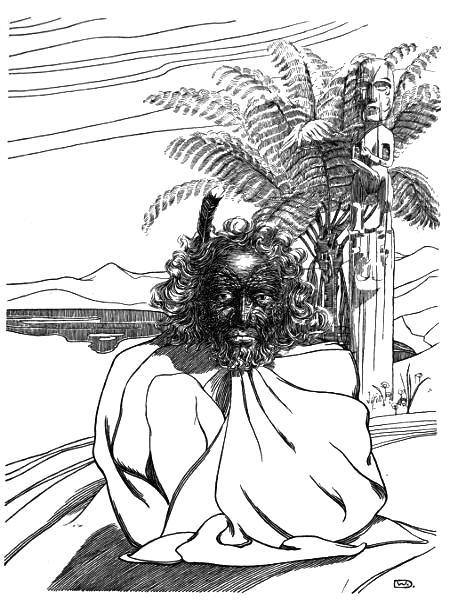
A TOHUNGA
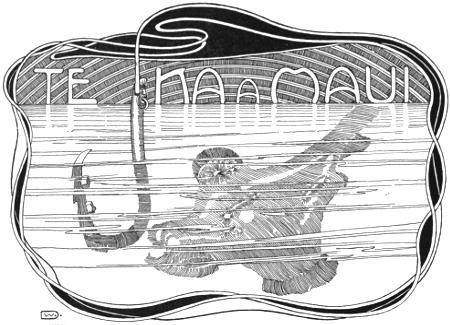
TE IKA A MAUI
Listen:
Taranga was his mother, but—ah, for Tama-nui-ki-te Rangi! ah, for Tama-nui-ki-te Rangi, what would have become of Maui? But a prey of the birds of the sea, ah! Tama found a bundle of jellyfish and sea-kelps on the shore, and the sea-birds were collecting around it fighting and screaming; so he went, and, stripping the fish and sea-kelps, he saw that they were covering and enclosing a child—Maui-potiki.
Ah, behold Maui-potiki, Maui, the infant, reared and fashioned by the fish and the weeds and the waves, by storms and gales of the rolling sea—ah, but for Tama-nui-ki-te Rangi, what would have become of Maui, alone on the shore? What but a prey of the sea-birds?
Maui-potiki!
Ah, Listen:
Before his time Maui was born, and Taranga, his mother, who gave birth to him on the border of the sea, knew that he could not live; therefore she cut her hair, and, wrapping it around him, she threw him into the surf of the sea—ah. She sang many incantations which have power over the evil spirits; for know, my listener, they are watching for the children who are born to life, before their life is ripe. They try to enter the body and fill the departing spirit of the child with hatred for man—for the departing spirit will never know and receive the joys of man; and therefore, friend, the dead-born children form the multitude of evil spirits.
Ah, great were Taranga’s incantations, but what would have become of Maui but for the love of Tangaroa? Tangaroa, the god of the oceans! His are the waves, and they rolled and rocked the child to sleep, and they fashioned him and gave him strength; and they took possession of him and gave him the power of the sea and the wisdom of the sea—their great incantations which unite heaven and earth; and they gave him the terrible witchcraft of the sea.
Then, rolling him gently on the sand of the beach, the jellyfish robed him, and the seaweeds—ah, my listener!
Tama-nui-ki-te Rangi became his father, and he lived with him till he grew into manhood. Many were his deeds, and great was his cunning: he learned powerful incantations, and he learned how to take the shape of the birds.
At last a great longing for his parents and his brothers grew in his heart, and he set out to seek them, for his heart was longing for them. He wandered and wandered toward the Edge of the Ascending Sun, and many days more he wandered, till he came to the great whare-puni; and all the people were there, and full of enjoyment and happiness.
He saw a woman who was counting her sons:
“Maui-i-mua—my eldest;
Maui-i-roto—my second-born;
Maui-i-taha—my third son; and
Maui-i-pai—my other son;”
and, perceiving Maui-potiki, she demanded: “Whom do I see among my children?”
Maui, assuming before her eyes the form of a pigeon, flew upon the forehead of Rangi, whose carved image supported the house, and, sitting there, he spoke: “If you are Taranga, my mother, then know, that I am Maui-potiki, your youngest son.”
Ha! great was the wisdom given him by Tangaroa, and great was his beauty and strength, fashioned by the storms of the sea, so that, when he took the form of man again, his mother saw his great beauty and she believed in him, and knew that he was her son; and she spoke:
“Do you come from the North?”; and Maui answered: “No.”
And again she asked: “Do you come from the South?” Maui again answered: “No.”
And she asked again: “Do you come from the West?” Maui again answered: “No.”
And she spoke again: “Do you come from the East?”—and again Maui answered: “No.”
She said: “Do you come on the waves of the sea?”—and Maui spoke: “The waves of the sea rolled me.”
And she said: “Do you come on the waves of the wind?”—and Maui said “Yes!”
Then Taranga cried: “It is true! He is the youngest son to whom I gave birth, and cast his body into the sea because his life was not ripe. He is here again; he is alive; it is true, it is true, it is true! He is my son; he is Maui-i-tiki-tiki-a-taranga!”
Ah, listen, my friend to Maui; Maui, my ancestor!
Three times he slept in the house of his mother, but every morning when he awoke he found his mother had disappeared before day-break.
The next night, when Taranga had come again to sleep with her sons, he waited till all were asleep, and then he closed every hole and rent through which light could come into the house, and put away Taranga’s feather-garment and belt, that she might not be able to go away again. In the darkness now Taranga slept till the Sun was standing high, and she cried and searched for her garment and belt. Not finding them she covered herself with an old mat, and ran to a tuft of reeds which grew near the house, and disappeared beneath it.
Maui followed her, and, lifting the tuft, he found that it covered the entrance to a cave.
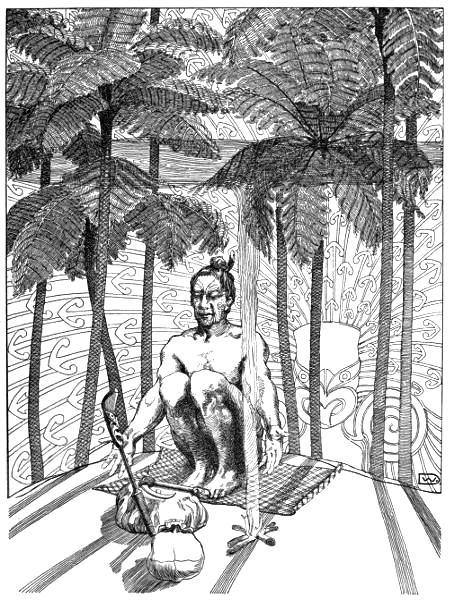
MAUI CHANTING INCANTATIONS Quickly now he changed himself into a pigeon, and, binding the white belt of his mother around his neck and her black feather-garment before his breast, he flew to the entrance of the cave, and, entering it, he flew and flew and flew through the long and dark cave till he saw at last the people of another world. Thither he flew, and rested upon a large tree. Sitting there, he perceived that his mother and father were among the people, and he threw down two berries, hitting both, his mother and Makea-tu-tara his father. They thought the berries had fallen from the tree, and took no heed; but Maui threw and hit them again, and then again. At last all saw the pigeon, and they began to throw stones, to kill it; but they could not hit Maui until at length he wanted them to, and then he fluttered down to the feet of his father. The people now sprang forward to kill the pigeon, but Maui quickly changed into a man again, so that they were struck with fear, and looked frightened into his staring red eyes: they were as red as if they were painted with kokowai.
Ah, my listener, Taranga, seeing her son, chanted the great Song of Welcome of the people of Hawaiki; and then, staring far into the distance, she sang the incantations to the gods who record the past, and with their help she narrated to the people all that had taken place since Maui’s birth, and the people wondered, and believed that Maui was Taranga’s son—Maui-i-tiki-tiki-a-taranga.
And from that time, Maui lived with his people for time, and time, and time.
At last, Maui, full of knowledge and cunning, wished for a weapon, so that he might perform great deeds that no other men could do. He wished for a sacred weapon, and he held many Karakias to the gods whose abode is the tools of the warrior.
One day he asked the people who brought food every day to Muri-Rangi-whenua, his grandfather, and said: “Give me the food that I may take it to Muri-Rangi-whenua, for is he not a sacred man?” And they gave it to him, and he carried it away; but did not give it to his ancestor. Many were the days that passed since he took the food away; but he did not give it to the old man, whose cries became louder and louder, for he was very old and hungry.
At last the spirit of his life took his abode in the jawbone, and, departing from there to be swallowed by Hine-nui-te-po, he left the jawbone—as his last resting-place, tapu (sacred)—behind him.
Ah, behold now, my stranger, how, taking the sacred jawbone of Muri-Rangi-whenua, he became the possessor of his powerful weapon. And truly wonderful deeds did he perform with his sacred weapon. Is not all this land its prey—this land, Te-ika-a-Maui? Look how he wanders till he reaches a place on the river at Hawaiki—look how he does not touch any food—look how he distributes the great tapu over the place, how he makes it sacred to the most powerful gods only, and—look, ah, look how he forms the jawbone of Muri-Rangi-whenua into a beautiful fish-hook; how he adorns it with carvings, and how its eyes of pawa-shell, flash fire into the world! Ha, look, my friend, how he, with great cunning, fashions the teeth into barbs! Ah, see him giving to his weapon the great name of his ancestor, Muri-Rangi-whenua.
Ha, now he held the great Karakia over his fish-hook, making it sacred as an abode for the mightiest gods; and, hiding it in his belt, he went back to his brothers, and he watched them trying to catch fish; but could never land them, for their hooks had no barbs. He said laughingly: “O, brothers, let us together go upon the sea to find out who may catch the largest fish.”
But his brothers were afraid of Maui and his cunning and witchcraft: they did not like him in the canoe, and therefore they left so early next morning that Maui had to stay behind.
When Maui awoke and found his brothers gone, he laughed, and changed himself into the little bird, Ti-waka-waka, and flew out upon the sea. When he had reached the canoe he set himself upon the prow, and began to twitter and sing.
Then his brothers knew him, and cried: “It is Maui, oh, it is Maui, who has come!”—and Maui, flying around the canoe, twittered: “Yes, brothers, it is Maui, it is Maui, who has come, Maui, Maui!” Then, throwing off all his feathers one by one, he took the form of man again, and spoke: “Ha, my brothers, now you shall see how Maui catches his large fish, and you shall not know its name! But let us go further out upon the sea—there, where the sea is deep, there is Maui’s fishing-ground.” His brothers now paddled and paddled, till at last they said: “Truly Maui, this must be your fishing-ground, for we can see Hawaiki no more.” But Maui answered: “No, no,—let us go further out—where there is no more end to the sea.”
At last they came to a place in the middle of the ocean, and Maui spoke: “Eh-hu, my brothers, this is Maui’s fishing-ground, the great battle-field for his fish-hook, Muri-Rangi-whenua.”
Now he took his fish-hook with great care, so that his brothers might not see the barbs, and asked them to give him some of their bait; but they laughed, and cried: “No, no; mighty Maui, show us your big fish, the fish we do not know—the fish you catch without bait!—ho, ho, the great fish of Maui!”
Ha, ha, my friend.
But now, in great rage, Maui tore half his hair out, and, soaking it with his blood, he baited his hook with it. Then he threw his line far, far out into the sea, and began to chant this great incantation:
“Blow gently from the wakarua,
Blow gently from the mawaki
My line, let it pull straight,
My line, let it pull strong;
It has caught,
It has come.
The land is gained.
The fish is in the hand—
The fish long waited for,
The boast of Maui,
His great haul,
For which he went to sea,
His boast, it is caught!”
Ha, see how his fish has swallowed the hook! Ha, see how his line straightens; see how Maui pulls and pulls with all his mighty strength! See, how his strength presses the canoe under water! Ha, listen how his brothers cry and wail; ha, ha, listen! “Maui, Maui, let go; let your fish go; oh, let go, let go, Maui!” Ha, ha, see how Maui pulls, and pulls, and pulls; see him pulling for three moons! Ha, listen how he shouts to his brothers: “What Maui has got in his hands he cannot let go again!”
Hearken now to his incantations to the gods who make heavy things light—ah, see him gathering together all his mighty strength, ah, see him pull, see him pull! Ah, friend, the sea foams, the sea thunders, the sea storms—ha, oh see, ah—ha, behold the fish of Maui, Maui’s fish swimming upon the surface of the sea—Maui’s fish—Ha, friend, it is this land! It is Te-ika-a-Maui.—Aotea-roa, this land.—Ah, behold the wisdom of my ancestors: how Maui’s hook caught the house of the old Tonga-nui on the top of Tongariro, and pulled all this beautiful land out of the sea, Te-ika-a-Maui.
“Open now your throats that are still hoarse and tired from crying, my brothers, and tell me the name of my fish”: so spoke Maui boastingly; but they could not give the name of the fish, and Maui said full of pride: “It is Te-ika-a-Maui!”
The canoe was now lying on the mountains at Hiku rangi, and Maui’s brothers took their weapons and sprang forth, and wounded and killed the fish, and, ah, my friend, from that time are the hills and the valleys and the mountains: they are the foot-prints of the brothers who did not follow Maui’s bidding that they should wait till he had made offering to the gods that they might regard his catch with favour, and that his fish might retain its beautiful smooth surface for ever.
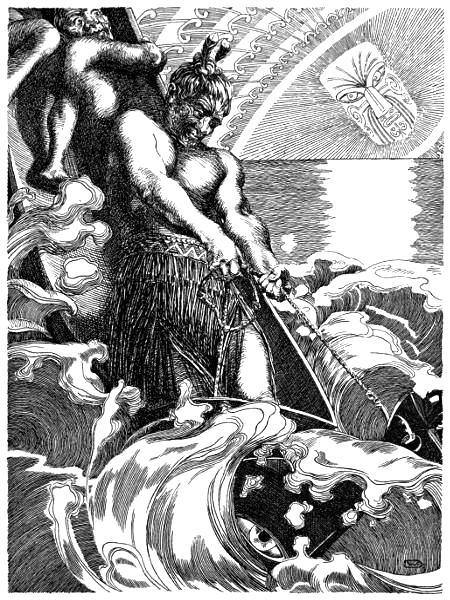
MAUI FISHING NEW ZEALAND OUT OF THE OCEAN
No, they did not follow Maui’s advice. Maui, our ancestor——Ah——(murmuring very low): Maui-i-tiki-tiki-a-Taranga——
Ah,——(and lower still): Angi, angi ki te wakarua——Angi, angi ki-te-ma-wa-ki——Tuku——aho——to——
Respect demands sleep.
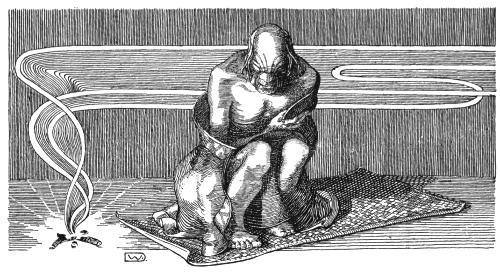
Tapu is the sleep of the very aged.
The Love of Hinemoa
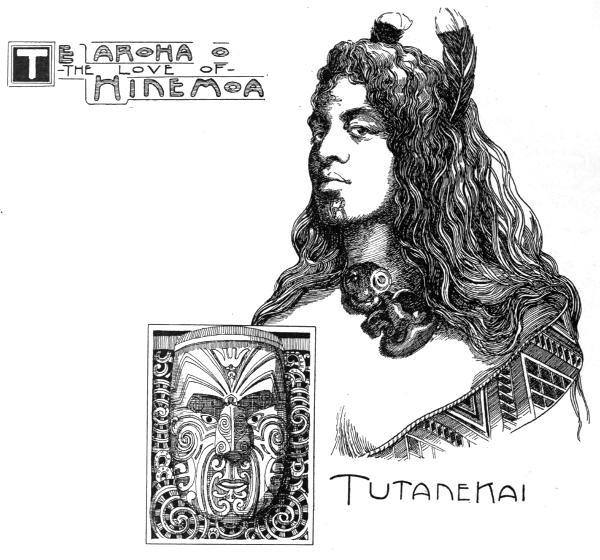

High above the sandhills Rangi the mighty spreads his Garment of Day. It is adorned with a border of snow-white clouds, which is resting on the distant hills of Papa, Papa, the happy.
Ah, she is sending white cloud-messengers of her love up to Rangi, to Rangi, the smiling, the beloved of Papa.
His golden Eye of Day caresses Papa, and looks down upon her with tenderness, and her blood mounts blushing into her cheeks of snow-white cliffs, and higher into the crimson glory of the flowering Pohutukawa-trees which crown the cliffs. The crimson flowers flutter down on the beach, of which Tangaroa, the unresting, takes possession again with long-rolling lines of froth borne on transparent waves and thrown ashore with majestic laughter and thundering songs to Papa, the beautiful mother.
“See, how Rangi’s Eye of Day looks down, my good friend, filling the heart with longing. Ah, longing for happiness enters the heart of man, and Hine-nui-te-po is forgotten.”
“Tell me, Ngawai, my good friend, what you have heard of the people who have wandered before us on the path to the Mother of Rest. Tell me what you have heard listening by the fires of the whare.”
“Listen then, while we wander along the border of the sea to the love that has been, the love of both, the two, of Hinemoa and Tutanekai.”
“The clear waters of the Waitemata never gave back such a beautiful image, nor did the flowing water of the Waikato nor the bottomless depth of Taupo-moana, as did the lake Rotorua on the evenings when the world was calm and Hinemoa looked down into the depths and was full of gladness.”
Ngawai commences her narrative while the sun paints a blue halo in the black hair around her head. The light plays in the sunburnt face, the lips quiver, and the large eyes, full of light, see in the distance what the lips utter.
“Oh, Hinemoa was full of gladness and was smiling at her image for joy, for over the sea sweetly sounds the music of the flute and the horn played by Tutanekai and his friend Tiki, far off in the middle of the lake on the island of Mokoia, Tutanekai’s home.”
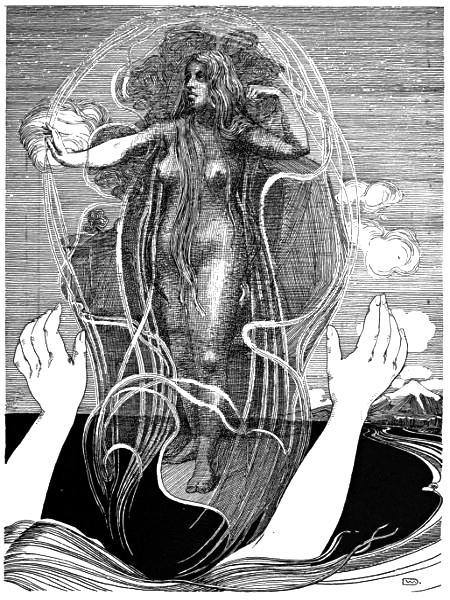
HINEMOA And she sat and listened murmuring to the water: “Oh, Tutanekai, how sweet is thy music to my heart! On many a calm night has Hinemoa listened, and her joy grew always greater, and her heart happier within her. Sometimes there were great gatherings of the people on the mainland, in the pa (village) of Amukaria, Hinemoa’s father, and Tutanekai came over, but he felt sorrowful amidst the feasting and frolic. He stole quick glances at the beautiful maiden, but his hand was trembling and he was ashamed; and he glanced over where Hinemoa was sitting like a beautiful white heron among a flock of Kiwi, and his heart was frightened. He was frightened and ill, and was full of wrath over it, as over a lizard that ate away his heart. Therefore he longed for powerful enemies, to fight away his trembling, and thus to forget his fear.
So he collected his war-friends and went away like a dark cloud to the tribe of his enemies, challenging them to battle; and great was the fighting, and many were slain, but Tutanekai was victorious, so that he took many slaves and made great offerings to the God of War.
The great battle and the many offerings to the War God gladdened his heart again, and he was frightened no more.
But again, when he was home with his friend Tiki, his music wandered over the water, and took his heart away to Hinemoa, and it brought back her image, as she listened on the shore, and sorrow again grew within him. So he sent Tiki, his friend, to Hinemoa, to tell her of his great sorrow in being away from her, and to ask her to come to him and to his heart, that it might lose its fright and be full of gladness.
Watchful was Amukaria, but Tiki gave his message, and full of gladness answered Hinemoa: “Eh-hu, is then each of us growing in the heart of the other?”—and she promised to come to Tutanekai in a canoe, late on a black night, when he would play his sweetest music to call for her and to guide her in the darkness.
Amukaria, a great Ariki, was only willing to give Hinemoa as wife to a Rangatira of a very high mana, for her beauty was like the Morning Sun over the lake, and he, knowing the power and danger of such beauty, gave order that all the canoes should be taken off the lake. Thus, when the sweet music of Tutanekai called for Hinemoa, she wandered boatless on the shore, her heart full of tears, for she could not answer Tutanekai’s calling.”
Her eyes full of tears, Ngawai wandered along the rolling waves, telling herself in low tones, in Maori, of all the sorrows of Hinemoa, her ancestress. Ngawai accompanies her mutterings with movements which express despair; presses her hands against her heart; stretches her arms longingly over the ocean and presses them again to her bosom; then she speaks with a different voice and rapidly:
“One evening Hinemoa sat listening upon the rock Iri-iri-kapua, and suddenly the longing to go shook her as an earthquake. The trembling of love overtook her, and the courage of love overflowed her heart.
She went to the store-house, and took six dry and empty gourds, and tied them together with flax for floats, and she went to the edge of the water, called Wai-rere-wai, threw off her mat of kiwi feathers, and cast herself to swim the long, long way with the help of the floating gourds. Oh, my friend, behold Hinemoa like a beautiful flying star casting herself into the water!
Oh, Hinemoa, the brave!”
Silent is Ngawai: her lips are murmuring incantations to Tangaroa; her hands tremble; her eyes are fixed far away in the distance.
“Ah, there, behold, she is there where the stump of the sunken tree stands in the lake——
Oh, Hinemoa!
Her arms are weary and her bosom is panting as she holds on to the branches of the tree.
Ah, now has darkness swallowed her!—oh her heart is brave!——
On she goes, on, on, weary her limbs, her breast panting, darkness around; but nearer and nearer comes the sweet music, nearer, nearer, and at last, with all her strength gone, her hands reach the rocks of Mokoia, where the hot spring is in the cave Wai-ki-miha. In this cave she took shelter, for she was cold, and trembling like a dead leaf. Trembling were her hands, but her heart was full of joy! Weary were her limbs, but her love was great and happy!”
Ngawai is striding with quick steps forward, heaving is her bosom, but in her eyes is fire and she is murmuring to herself. Her heart and thoughts are far away among the waves of the lake Rotorua, battling there with the water, as Hinemoa did, her ancestress.
“Long, long was the way over the water—oh, great was the love of Hinemoa!—
Whilst she was warming herself in the cave, there appeared at the narrow edge a slave, sent by Tutanekai, to fetch some water; and when he had filled his calabash Hinemoa called out to him: ‘Slave, for whom is that water?’—and the frightened slave answered: ‘For Tutanekai, my ariki.’ Hinemoa spoke: ‘If it is for Tutanekai, then give it to me,’—and the frightened slave reached her the calabash, and she drank and broke it on the rocks. The slave called out: ‘Why did you break Tutanekai’s calabash?’ But Hinemoa never answered.
Again did Tutanekai send the slave, and again spoke Hinemoa: ‘Give me Tutanekai’s calabash’—and again the frightened slave reached it to her into the darkness, and she drank and broke it again.
When Tutanekai heard the words of the slave, he reached full of wrath for his war-weapon of whalebone, calling, so that it sounded all over the island: ‘Woe be to the man, woe be to the bad spirit, woe be to him who broke my calabashes! I will make a calabash out of his skull!’”
Harsh come the words from Ngawai’s lips, but full of laughter are her eyes, and she wanders a while, smiling to herself.
“Tutanekai, in the dark cave, his powerful weapon lifted for a deadly blow cried fiercely: ‘Who is that enemy, that I may give his name to my cup which I will make out of his skull?’
A voice answered softly out the darkness: ‘It is I’—and the beautiful Rangatira, dressed in her flowing hair, stretched longingly her arms towards Tutanekai: ‘O, Tutanekai, my ariki, kill me, kill Hinemoa.’
Ha! the powerful weapon fell to the ground like a useless stick; forgotten was the God of War; forgotten the lizards: sorrow and fear and full of love sounds the voice out of the cave: ‘Hinemoa!’
And from the rocks it echoed over the lake: ‘Hinemoa!’”
Long is Ngawai staring in her hands, squatting down on the beach, then form her lips one word: “Hinemoa.”