 Curio Class
Creatures of Old
Veena Prasad
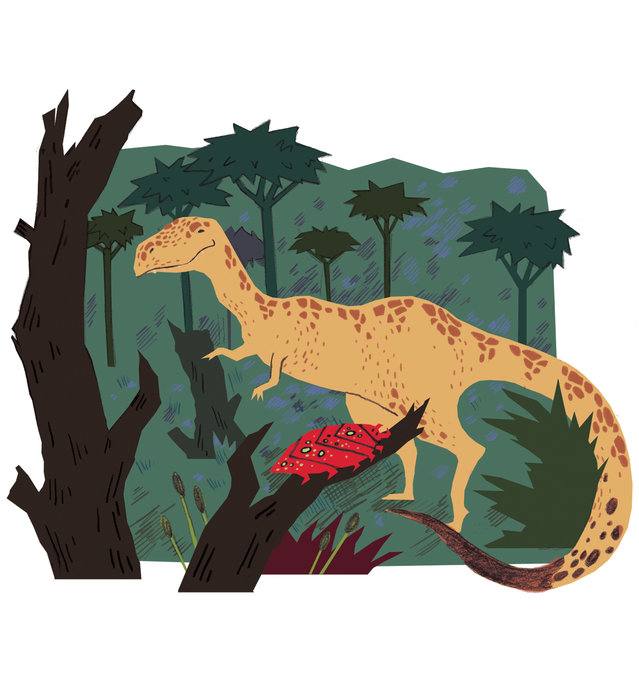
The sun had just set, and the forest was in darkness. A huge lizard-like creature was hiding in the bushes. It was still as a statue, from the tip of its snout to the curve of its tail. Only its sharp eyes moved, darting left and right. Its nostrils twitched as it smelled dinner. A juicy little insect!
The giant lizard got ready to pounce when . . .
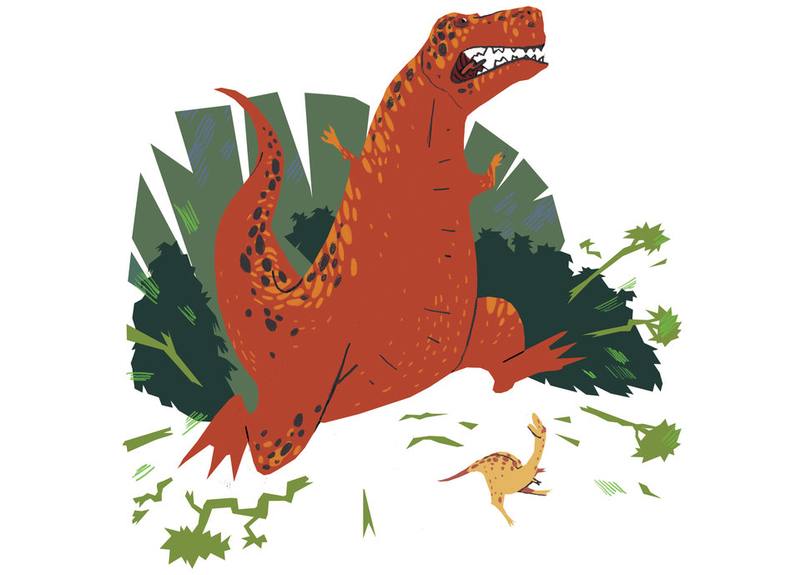
Suddenly, the ground rumbled and shook. Animals were running in all directions. The poor lizard-creature was almost run over. Angrily, it turned back to see what was causing all the confusion. GULP!
A terrifying beast was charging down the forest path. It was taller than the tallest trees, and had skin as rough as rock.
Oh no! Was the hunter about to become the prey?
This is NOT a story.
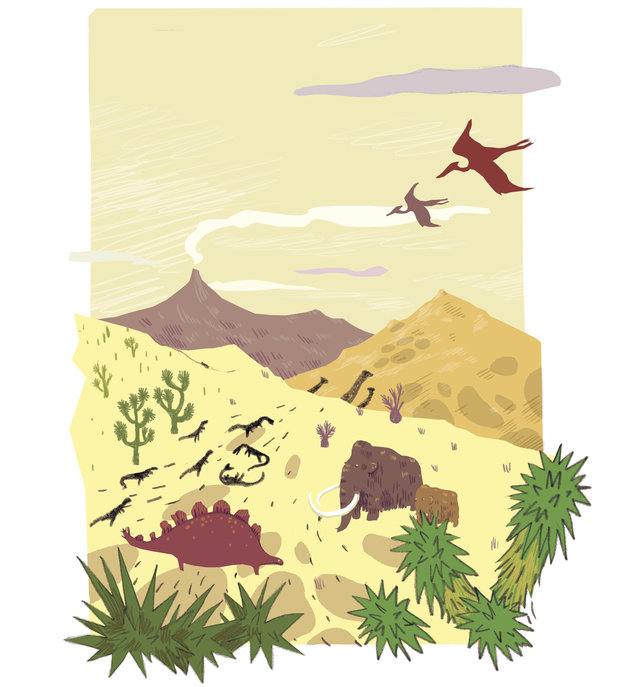
Such creatures actually lived on Earth a long, long time ago. A time when there were no humans or dogs or birds.
Instead there were mammoths, dinosaurs, giant insects, and even ferocious fish-like creatures in the oceans. There were also strange-looking plants different from those we have today.
How do we know this?
Because of science. A very special branch of science called ‘Palaeontology’ (pronounced pay-lee-on-tol-oji). Palaeontology is the study of plants and animals that lived on Earth many, many years ago. And paleontologists are scientists who study this science.
Just as the ruins of an old palace can tell us things about a king from the past (like how grand his throne was, or what his favourite weapon was), there are clues deep inside the earth that can tell us many things about ancient animals.
The clues come in many forms—bones, footprints, eggs, and sometimes even the body of an entire animal preserved in stone!
These animals lived millions and millions of years ago, long before apes or humans appeared on Earth! How did their remains not rot and decay? And how are they still preserved?
Well, when these creatures died and as they rotted, they got buried under layers and layers of soil. The skin and flesh decayed and disappeared, but the hard bones and teeth remained because of the tightly packed soil.
All these layers of soil, along with the bones, became hard and turned into rock. Plant and animal remains preserved as imprints in this rock are called fossils.
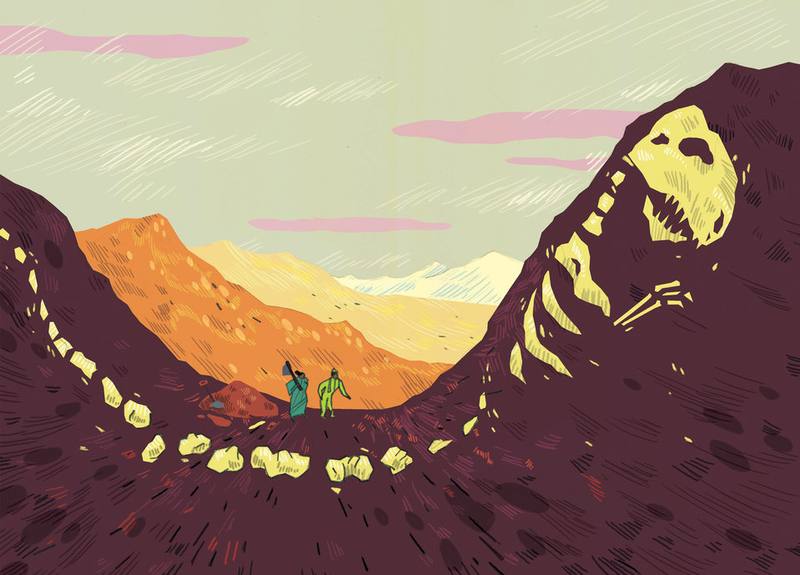
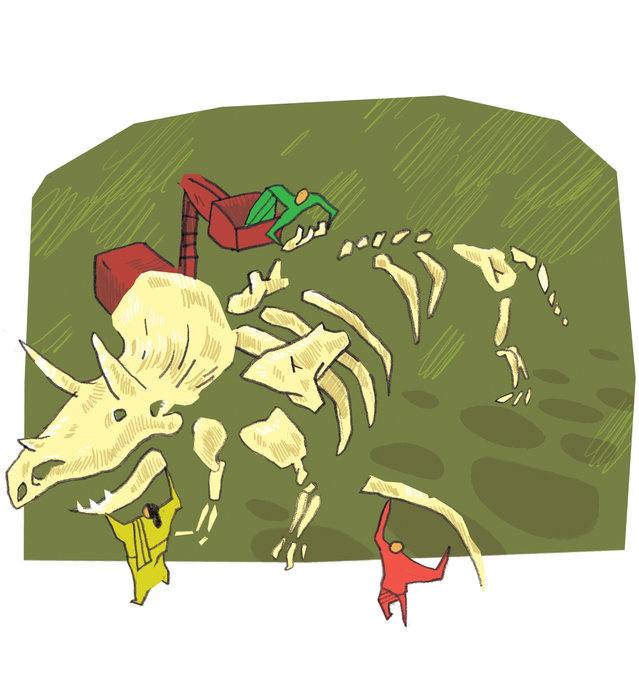
When scientists first discovered huge bones buried under the surface of the earth, they did not know what these were. The bones were larger than any animal they had ever known. Bones as long as tree trunks, skulls the size of autorickshaws, teeth as big as ice-cream cones, and claws like knives!
They kept putting the bones together in different ways to see if they could come up with an animal they recognised. Finally, it all clicked into place, like a puzzle.
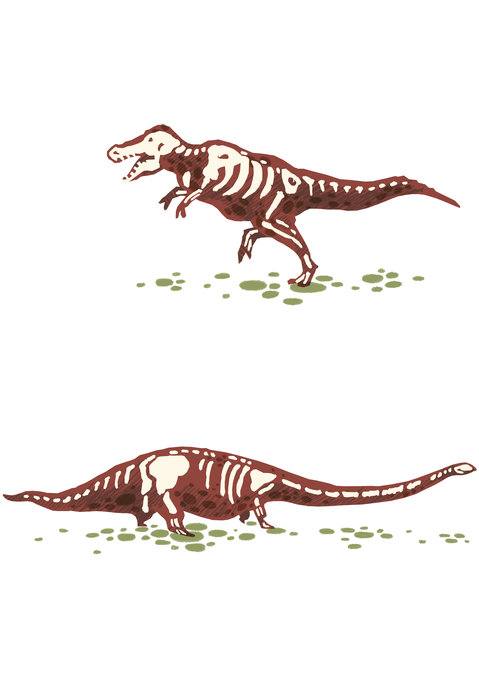
Paleontologists can tell a lot about an animal from its skeleton. For example, if the bones of the legs are much larger than the bones of the forelimbs, it is possible that this animal walked on two legs. Just like that gigantic creature we met earlier! That fearsome creature is called Tyrannosaurus Rex (T.rex for short).
If the bones of all the legs are equal in size, there is a good chance that this animal walked on all fours – like the Diplodocus which had four stout legs and a really long neck.
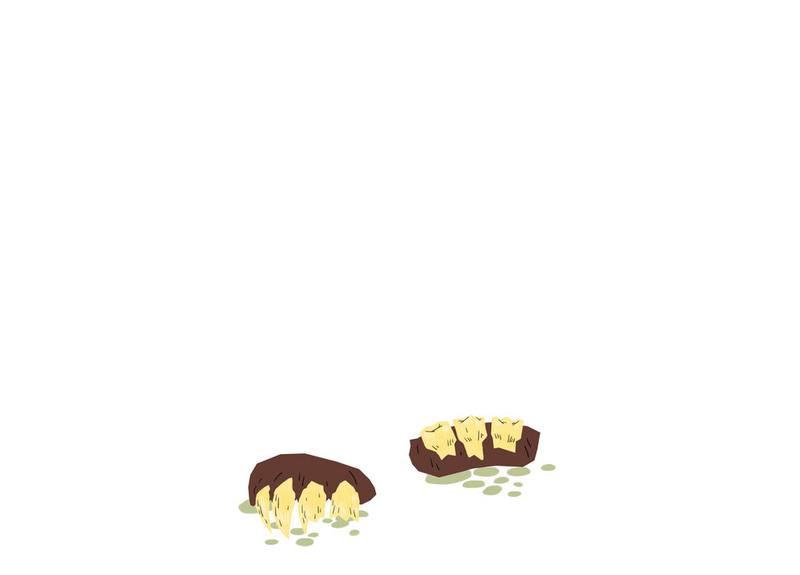
Fossils of their teeth give great clues about what ancient creatures liked to eat. Many skeletons had long, sharp teeth which are good for eating meat. Some skeletons had flat, broad and smooth teeth good for chewing leaves and the bark of trees. They were good for chewing leaves and the bark of trees. So we know that there were some vegetarian dinosaurs too!
But scientists don’t always find entire skeletons. They discover only a few bones – a finger here, a rib there, or maybe just a couple of bones from the spine.

Not all fossils are bones. Some are just marks, like footprints we leave when we walk on soft mud. Dinosaurs left footprints too, and before these prints could disappear, the soil got covered with layers of sand and rock. So the prints stayed intact for millions of years.
In fact, by measuring the distance between footprints, paleontologists can guess the height of the animal. They can also tell how it stood and walked.
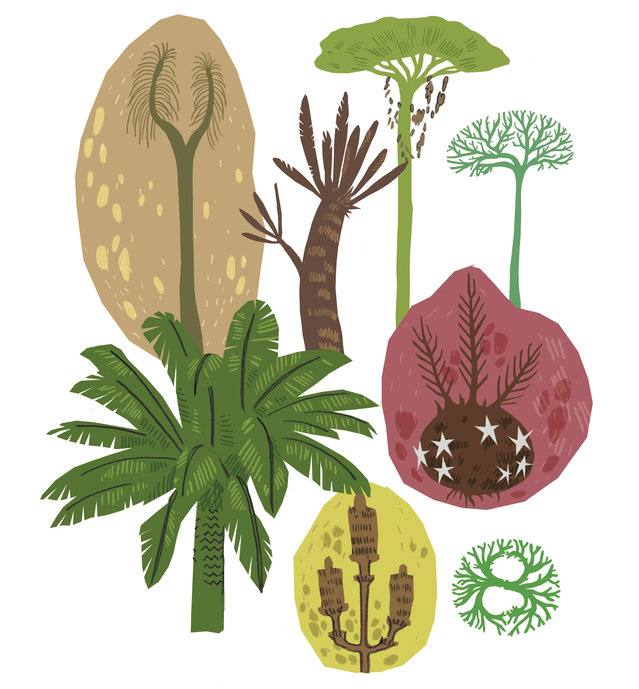
Some of the strangest fossil marks were left by plants. Paleontologists have discovered interestingly-shaped leaves and flowers that cannot be seen anywhere today.
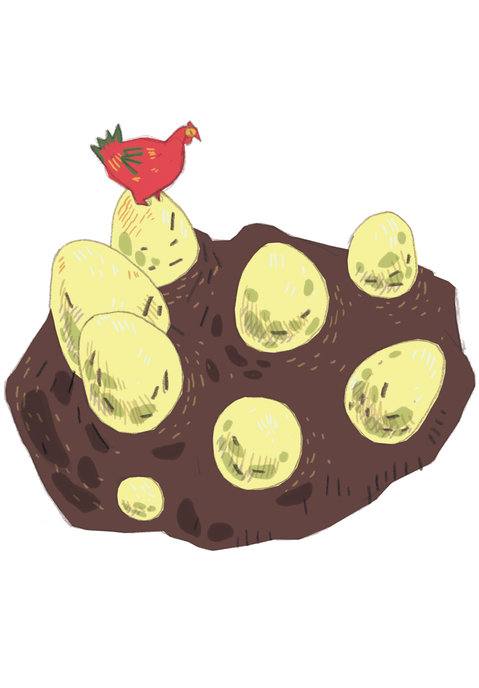
But here’s the most fun clue of all!
Any idea what this might be? Is it a football? Is it a cannonball? Is it an egg?
That’s right! It’s an egg! A giant, fossilized egg.
Scientists have found whole eggs that even contain the outline of an unhatched baby dinosaur inside! Perhaps they got buried in a landslide or lava from a volcano before they could hatch.
In Mongolia, scientists discovered eggs along with the skeleton of an adult dinosaur in an attacking pose. They thought that the big dinosaur, fancying an omelette for breakfast, had come to eat the eggs. They named it Oviraptor, meaning ‘egg hunter’.
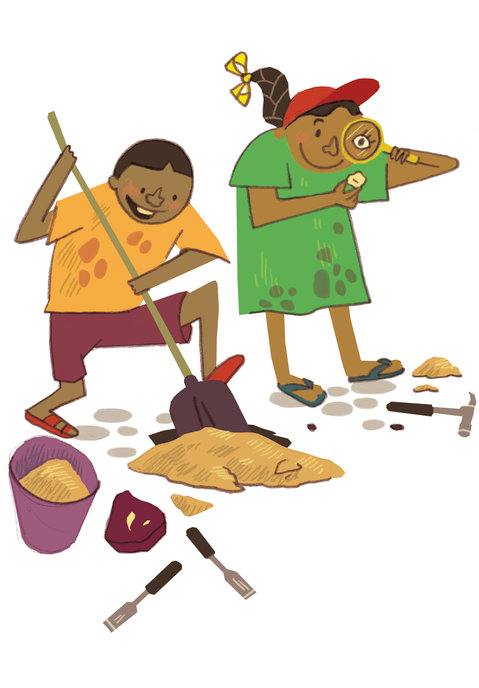
Soon, they started discovering many fossilized eggs close to Oviraptor skeletons in different poses. They realised that it was actually the parent dinosaur protecting its own eggs, and not trying to eat them! Most unfairly, the name Oviraptor stuck.
As you might have guessed, we don’t know everything about these creatures yet. There are a lot of clues that don’t really fit, and some clues were put together all wrong. Scientists are still trying to figure them out.
There is a lot of digging to be done! Would you like to be a paleontologist and help solve some mysteries? What are you waiting for? Grab a shovel!
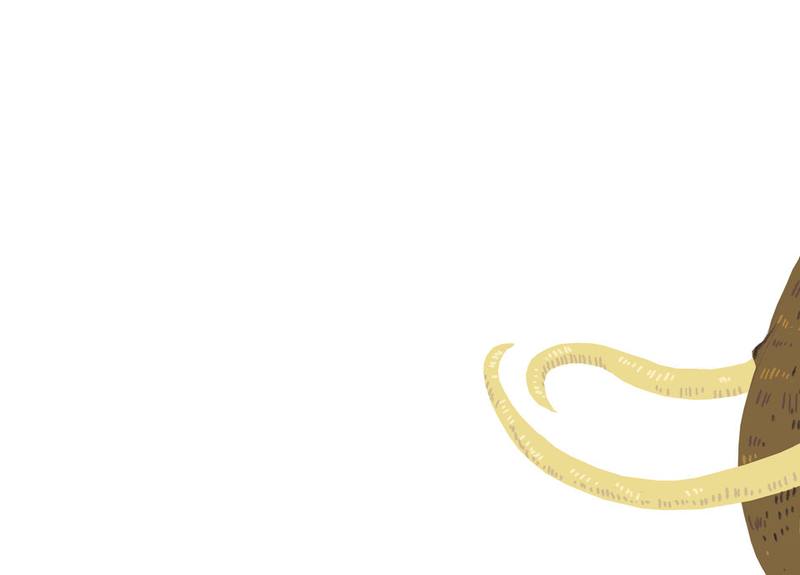
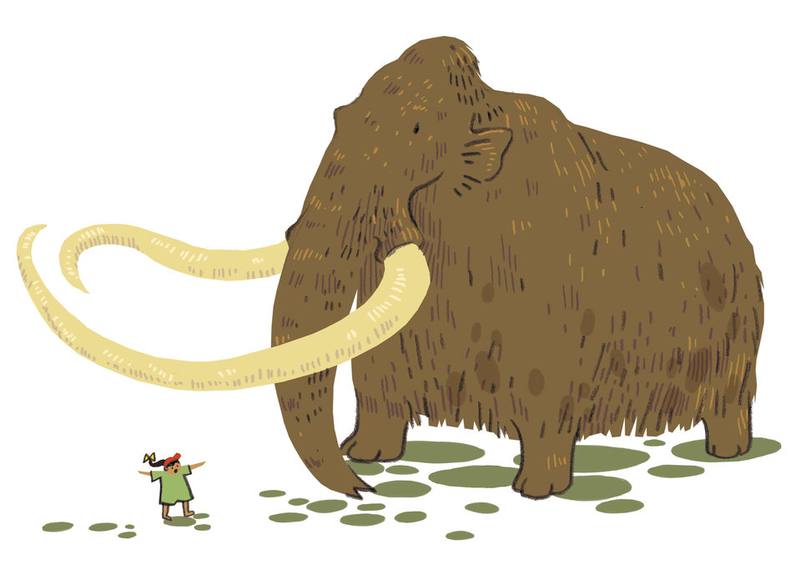
Meet some other fascinating creatures from the past.
Woolly Mammoth
These animals were related to elephants,
and had tusks that were 15 feet long!
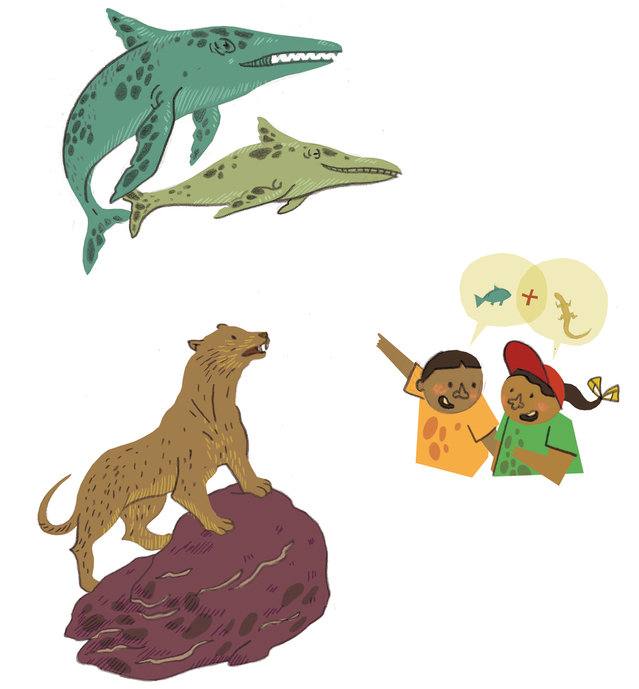
Ichthyosaurs
These creatures looked like fish but they were actually reptiles that lived in the sea. The name ichthyosaur means ‘fish lizard’ in Greek.
Bear dogs
These animals were neither bears nor dogs, but a group of animals related to both bears and dogs.