 Curio Class
West African folk tales (set II)
W. H. Barker and Cecilia Sinclair (collected)
Why the Lizard Continually Moves His Head Up and Down
In a town not very far from Anansi’s home lived a great king. This king had three beautiful daughters, whose names were kept a secret from everybody except their own family. One day their father made a proclamation that his three daughters would be given as wives to any man who could find out their names. Anansi made up his mind to do so.
He first bought a large jar of honey, and set off for the bathing-place of the king’s daughters. Arrived there, he climbed to the top of a tree on which grew some very fine fruit. He picked some of this fruit and poured honey over it. When he saw the princesses approaching he dropped the fruit on the ground and waited. The girls thought the fruit dropped of its own accord, and one of them ran forward to pick it up. When she tasted it, she called out to her sisters by name to exclaim on its [46]sweetness. Anansi dropped another, which the second princess picked up—she, in her turn, calling out the names of the other two. In this fashion Anansi found out all the names.
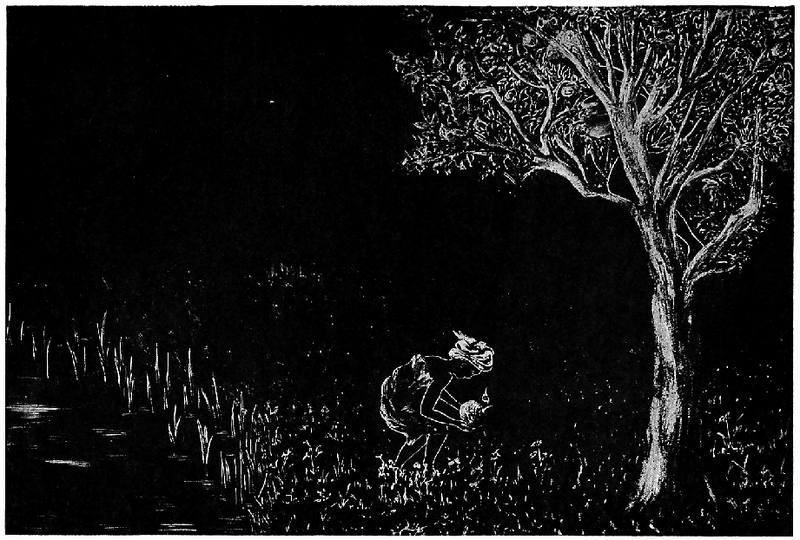
THE PRINCESS PICKED UP THE FRUIT
As soon as the princesses had gone Anansi came down from the tree and hurried into the town. He went to all the great men and summoned them to a meeting at the King’s palace on the morrow.
He then visited his friend the Lizard, to get him to act as herald at the Court next day. He told Lizard the three names, and the latter was to sound them through his trumpet when the time came.
Early next morning the King and his Court were assembled as usual. All the great men of the town appeared, as Anansi had requested. Anansi stated his business, reminding the King of his promise to give his three daughters to the man who had found out their names. The King demanded to hear the latter, whereupon Lizard sounded them on his trumpet.
The King and courtiers were much surprised. His Majesty, however, could not break the promise he had made of giving his daughters to the man who named them. He accordingly gave them to Mr [47]Lizard. Anansi was very angry, and explained that he had told the names to Lizard, so that he ought to get at least two of the girls, while Lizard could have the third. The King refused. Anansi then begged hard for even one, but that was also refused. He went home in a very bad temper, declaring that he would be revenged on Lizard for stealing his wives away.
He thought over the matter very carefully, but could not find a way of punishing Lizard. At last, however, he had an idea.
He went to the King and explained that he was setting off next morning on a long journey. He wished to start very early, and so begged the King’s help. The King had a fine cock, which always crowed at daybreak to waken the King if he wished to get up early. Anansi begged that the King would command the cock to crow next morning, that Anansi might be sure of getting off in time. This the King readily promised.
As soon as night fell Anansi went by a back way to the cock’s sleeping-place, seized the bird quickly, and killed it. He then carried it to Lizard’s house, where all were in bed. There he quietly cooked [48]the cock, placed the feathers under Lizard’s bed, and put some of the flesh on a dish close to Lizard’s hand. The wicked Anansi then took some boiling water and poured it into poor Lizard’s mouth, thus making him dumb.
When morning came, Anansi went to the King and reproached him for not letting the cock crow. The King was much surprised to hear that it had not obeyed his commands.
He sent one of his servants to find and bring the cock to him, but, of course, the servant returned empty-handed. The King then ordered them to find the thief. No trace of him could be found anywhere. Anansi then cunningly said to the King: “I know Lizard is a rogue, because he stole my three wives from me. Perhaps he is the thief.” Accordingly, the men went to search Lizard’s house.
There, of course, they found the remnants of the cock, cooked ready to eat, and his feathers under the bed. They questioned Lizard, but the poor animal was unable to reply. He could only move his head up and down helplessly. They thought he was refusing to speak, so dragged him before the King. To the King’s questions he could only return the [49]same answer, and his Majesty got very angry. He did not know that Anansi had made the poor animal dumb. Lizard tried very hard to speak, but in vain.
He was accordingly judged guilty of theft, and as a punishment his wives were taken away from him and given to Anansi.
Since then lizards have always had a way of moving their heads helplessly backward and forward, as if saying, “How can any one be so foolish as to trust Anansi?”
How the Tortoise Got Its Shell
A few hundred years ago, the chief Mauri (God) determined to have a splendid yam festival. He therefore sent his messengers to invite all his chiefs and people to the gathering, which was to take place on Fida (Friday).
On the morning of that day he sent some of his servants to the neighbouring towns and villages to buy goats, sheep, and cows for the great feast. Mr Klo (the tortoise), who was a tall and handsome fellow, was sent to buy palm wine. He was directed to the palm-fields of Koklovi (the chicken).
At that time Klo was a very powerful traveller and speedily reached his destination, although it was many miles distant from Mauri’s palace.
When he arrived Koklovi was taking his breakfast. When they had exchanged polite salutations Koklovi asked the reason of Klo’s visit. He replied, “I was sent by His Majesty Mauri, the ruler of the world, [116]to buy him palm wine.” “Whether he’s ruler of the world or not,” answered Koklovi, “no one can buy my wine with money. If you want it you must fight for it. If you win you can have it all and the palm-trees too.”
This answer delighted Klo as he was a very strong fighter. Koklovi was the same, so that the fighting continued for several hours before Klo was able to overcome Koklovi. He was at last successful, however, and securely bound Koklovi before he left him.
Then, taking his great pot, he filled it with wine. Finding that there was more wine than the pot would hold, Klo foolishly drank all the rest. He then piled the palm-trees on his back and set out for the palace with the pot of wine. The amount which he had drunk, however, made him feel so sleepy and tired that he could not walk fast with his load. Added to this, a terrible rain began to fall, which made the ground very slippery and still more difficult to travel over.
By the time Klo succeeded in reaching his master’s palace the gates were shut and locked. Mauri, finding it so late, had concluded that every one was inside.
There were many people packed into the great hall, and all were singing and dancing. The noise of the concert was so great that no one heard Klo’s knocking at the gate, and there he had to stay with his great load of wine and palm-trees.
The rain continued for nearly two months and was so terrible that the people all remained in the palace till it had finished. By that time Klo had died, under the weight of his load—which he had been unable to get off his back. There he lay, before the gate, with the pile of palm-trees on top of him.
When the rain ceased and the gates were opened the people were amazed to see this great mound in front of the gate, where before there had been nothing. They fetched spades and began to shovel it away.
When they came to the bottom of the pile there lay Klo. His earthenware pot and the dust had caked together and formed quite a hard cover on his back.
He was taken into the palace—and by the use of many wonderful medicines he was restored to life. But since that date he has never been able to stand upright. He has been a creeping creature, with a great shell on his back.
The Hunter and the Tortoise
A village hunter had one day gone farther afield than usual. Coming to a part of the forest with which he was unacquainted, he was astonished to hear a voice singing. He listened; this was the song:
“It is man who forces himself on things,
Not things which force themselves on him.”
The singing was accompanied by sweet music—which entirely charmed the hunter’s heart.
When the little song was finished, the hunter peeped through the branches to see who the singer could be. Imagine his amazement when he found it was none other than a tortoise, with a tiny harp slung in front of her. Never had he seen such a marvellous thing.
Time after time he returned to the same place in order to listen to this wonderful creature. At last he persuaded her to let him carry her back to his hut, that he might enjoy her singing daily in comfort. [120]This she permitted, only on the understanding that she sang to him alone.
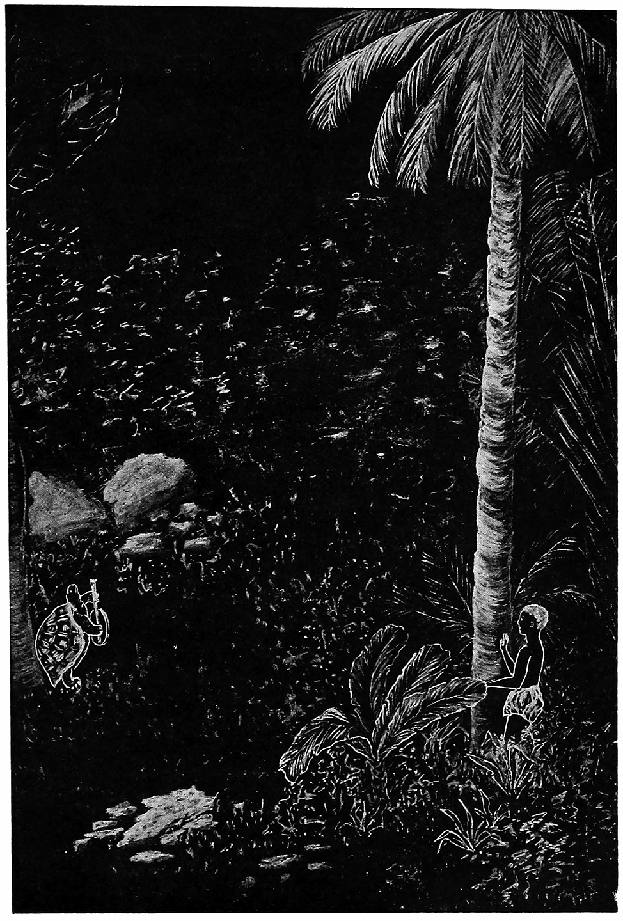
THE HUNTER AND THE TORTOISE
The hunter did not rest long content with this arrangement, however. Soon he began to wish that he could show off this wonderful tortoise to all the world, and thereby thought he would gain great honour. He told the secret, first to one, then to another, until finally it reached the ears of the chief himself. The hunter was commanded to come and tell his tale before the Assembly. When, however, he described the tortoise who sang and played on the harp, the people shouted in scorn. They refused to believe him.
At last he said, “If I do not speak truth, I give you leave to kill me. To-morrow I will bring the tortoise to this place and you may all hear her. If she cannot do as I say, I am willing to die.” “Good,” replied the people, “and if the tortoise can do as you say, we give you leave to punish us in any way you choose.”
The matter being then settled, the hunter returned home, well pleased with the prospect. As soon as the morrow dawned, he carried tortoise and harp down to the Assembly Place—where a table had been [121]placed ready for her. Every one gathered round to listen. But no song came. The people were very patient, and quite willing to give both tortoise and hunter a chance. Hours went by, and, to the hunter’s dismay and shame, the tortoise remained mute. He tried every means in his power to coax her to sing, but in vain. The people at first whispered, then spoke outright, in scorn of the boaster and his claims.
Night came on and brought with it the hunter’s doom. As the last ray of the setting sun faded, he was beheaded. The instant this had happened the tortoise spoke. The people looked at one another in troubled wonder: “Our brother spoke truth, then, and we have killed him.” The tortoise, however, went on to explain. “He brought his punishment on himself. I led a happy life in the forest, singing my little song. He was not content to come and listen to me. He had to tell my secret (which did not at all concern him) to all the world. Had he not tried to make a show of me this would never have happened.
“It is man who forces himself on things,
Not things which force themselves on him.”
The Tail of the Princess Elephant
There once lived a woman who had three sons. These sons were very much attached to their mother and always tried to please her. She at last grew very old and feeble. The three sons began to think what they could do to give her great pleasure. The eldest promised that when she was dead he would cut a fine sepulchre in stone for her. The second said he would make a beautiful coffin. The youngest said, “I will go and get the tail of the princess elephant and put it in the coffin with her.” This promise was by far the hardest one to keep.
Soon after this their mother died. The youngest son immediately set out on his search, not knowing in the least where he would be likely to find the tail. He travelled for three weeks, and at the end of that time he came to a little village. There he met an old woman, who seemed very much surprised to see [124]him. She said no human creature had ever been there before. The boy told the tale of his search for the princess elephant. The old woman replied that this village was the home of all the elephants, and the princess slept there every night. But she warned him that if the animals saw him they would kill him. The young man begged her to hide him—which she did, in a great pile of wood.
She also told him that when the elephants were all asleep he must get up and go to the eastern corner. There he would find the princess. He must walk boldly over, cut off the tail and return in the same manner. If he were to walk stealthily, the elephants would waken and seize him.
The animals returned as it was growing dark. They said at once that they smelt a human being. The old woman assured them that they were mistaken. Their supper was ready, so they ate it and went to bed.
In the middle of the night the young man got up and walked boldly across to where the princess slept. He cut off the tail and returned as he had come. He then started for home, carrying the tail very carefully.
When daylight came the elephants awoke. One [125]said he had dreamed that the princess’s tail was stolen. The others beat him for thinking such a thing. A second said he also had had the dream, and he also was beaten. The wisest of the elephants then suggested that they might do well to go and see if the dream were true. This they did. They found the princess fast asleep and quite ignorant of the loss of her tail. They wakened her and all started off in chase of the young man.
They travelled so quickly that in a few hours they came in sight of him. He was afraid when he saw them coming and cried out to his favourite idol (which he always carried in his hair), “O my juju Depor! What shall I do?” The juju advised him to throw the branch of a tree over his shoulder. This he did and it immediately grew up into a huge tree, which blocked the path of the elephants. They stopped and began to eat up the tree—which took them some little time.
Then they continued their way again. Again the young man cried, “O my juju Depor! What shall I do?” “Throw that corn-cob behind you,” answered the juju. The lad did so, and the corn-cob immediately grew into a large field of maize.
The elephants ate their way through the maize, but when they arrived at the other side they found that the boy had reached home. So they had to give up the chase and return to their village. The princess, however, refused to do so, saying, “I will return when I have punished this impudent fellow.”
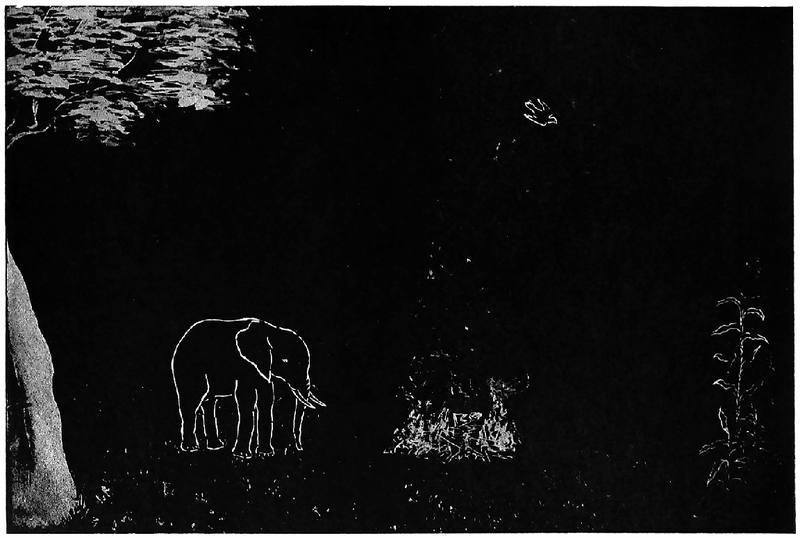
THE PRINCESS CHANGED INTO AN ELEPHANT
She thereupon changed herself into a very beautiful maiden, and taking a calabash cymbal in her hand approached the village. All the people came out to admire this lovely girl.
She had it proclaimed through the village that whoever succeeded in shooting an arrow at the cymbal should have her for a bride. The young men all tried and failed. An old man standing by said, “If only Kwesi—the cutter of the princess elephant’s tail—were here, he could hit the cymbal.” “Then Kwesi is the man I will marry,” replied the maiden, “whether he hit the cymbal or not.”
Kwesi was quickly fetched from the field where he was ploughing, and told of his good luck. He, however, was not at all delighted to hear of it, as he suspected the maiden of some trick.
However, he came and shot an arrow which struck the centre of the cymbal. The damsel and he were [127]accordingly married. She was all the time preparing to punish him.
The night following their marriage she turned into an elephant, while Kwesi was asleep. She then prepared to kill him, but Kwesi awoke in time. He called, “O my juju Depor! Save me!” The juju turned him into a grass mat lying on the bed and the princess could not find him. She was most annoyed and next morning asked him where he had been all night. “While you were an elephant I was the mat you lay on,” replied Kwesi. The damsel took all the mats from the bed and burned them.
Next night the princess again became an elephant and prepared to kill her husband. This time the juju changed him into a needle and his wife could not find him. She again asked him in the morning where he had been. Hearing that the juju had helped him again she determined to get hold of the idol and destroy it.
Next day Kwesi was going again to his farm to plough a field. He told his wife to bring him some food to the resting-place. This time she had fairly made up her mind that he should not escape. When he had had his food she said, “Now lay your head [128]in my lap and sleep.” Kwesi quite forgot that his juju was hidden in his hair and did as she bid. As soon as he was asleep she took the juju out of his hair and threw it into a great fire which she had prepared. Kwesi awoke to find her an elephant once more. In great fear he cried out, “O my juju Depor! What am I to do?” All the answer he got, however, came from the flames. “I am burning, I am burning, I am burning.” Kwesi called again for help and the juju replied, “Lift up your arms as if you were flying.” He did so and turned into a hawk.
That is the reason why hawks are so often seen flying in the smoke of fires. They are looking for their lost juju.
King Chameleon and the Animals
In the olden days all the animals of the world lived together in friendship. They had no one to rule over them and judge them. In consequence, many very wicked deeds were constantly being done, as no one needed to fear any punishment.
At last they all met together to discuss this bad state of affairs, and, as a result, they decided to choose a king. The great difficulty was how to choose him.
Lion was the first animal suggested. But all opposed him because, they said, he was too fierce. Wolf was next named—but the sheep and goats refused to have him because he was their foe. They knew they would have bad treatment if he were chosen.
As it was impossible to please every one by choice, they decided in another way. Two miles away was a great stool, placed under a very ancient tree which they believed to be the abode of some of their gods. [156]They would have a great race. The animal which reached and sat down first on the stool should be chosen king.
The day of the race arrived. All animals, great and small, prepared to take part in it. The signal being given, they started off. The hare—being a very fine runner—speedily outdistanced the others. He reached the stool quite five hundred yards ahead of the next animal. You may judge of his annoyance when, just as he was going to sit down, a voice came from the stool saying, “Take care, Mr Hare, take care. I was here first.” This was the chameleon. He, being able to change his colour to suit his surroundings, had seized Mr Hare’s tail just as the race began. Having made his colour match the hare’s, no one had noticed him. He had held on very tightly, and when the hare turned round to take his seat Chameleon dropped off and landed on the stool.
The hare saw how he had been tricked and was very angry. The other animals, however, arrived before he could harm the chameleon. According to the agreement they had made, they had no choice but to make Chameleon king.
But none of the animals were satisfied with the choice. So as soon as the meeting was over, all scattered in every direction and left Chameleon quite alone.
He was so ashamed that he went and made his home at the top of a very high tree on a mountain. In the dead of night you may hear him calling his attendants to come and stay with him. But he is left quite alone. “A king without subjects is no king.”
How Mushrooms First Grew
Long, long ago there dwelt in a town two brothers whose bad habits brought them much trouble. Day by day they got more deeply in debt. Their creditors gave them no peace, so at last they ran away into the woods. They became highway robbers.
But they were not happy. Their minds were troubled by their evil deeds. At last they decided to go home, make a big farm, and pay off their debts gradually.
They accordingly set to work and soon had quite a fine farm prepared for corn. As the soil was good, they hoped the harvest would bring them in much money.
Unfortunately, that very day a bushfowl came along. Being hungry, it scratched up all the newly planted seeds and ate them.
The two poor brothers, on arriving at the field next day, were dismayed to find all their work quite [178]wasted. They put down a trap for the thief. That evening the bushfowl was caught in it. The two brothers, when they came and found the bird, told it that now all their debts would be transferred to it because it had robbed them of the means of paying the debts themselves.
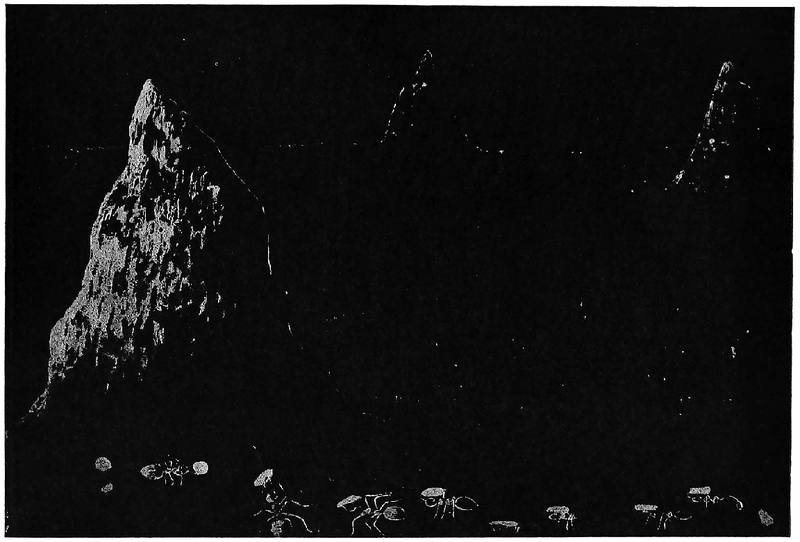
HOW THE ANTS PAID THE DEBT
The poor bird—in great trouble at having such a burden thrust upon it—made a nest under a silk-cotton tree. There it began to lay eggs, meaning to hatch them and sell the young birds for money to pay off the debt.
A terrible hurricane came, however, and a branch of the tree came down. All the eggs were smashed. As a result, the bushfowl transferred the debts to the tree, as it had broken the eggs.
The silk-cotton tree was in dismay at having such a big sum of money to pay off. It immediately set to work to make as much silk cotton as it possibly could, that it might sell it.
An elephant, not knowing all that had happened, came along. Seeing the silk cotton, he came to the tree and plucked down all its bearings. By this means the debts were transferred to the poor elephant.
The elephant was very sad when he found what [179]he had done. He wandered away into the desert, thinking of a way to make money. He could think of none.
As he stood quietly under a tree, a poor hunter crept up. This man thought he was very lucky to find such a fine elephant standing so still. He at once shot him.
Just before the animal died, he told the hunter that now the debts would have to be paid by him. The hunter was much grieved when he heard this, as he had no money at all.
He walked home wondering what he could do to make enough money to pay the debts. In the darkness he did not see the stump of a tree which the overseers had cut down in the road. He fell and broke his leg. By this means the debts were transferred to the tree-stump.
Not knowing this, a party of white ants came along next morning and began to eat into the tree. When they had broken it nearly to the ground, the tree told them that now the debts were theirs, as they had killed it.
The ants, being very wise, held a council together to find out how best they could make money. They [180]decided each to contribute as much as possible. With the proceeds one of their young men would go to the nearest market and buy pure linen thread. This they would weave and sell and the profits would go to help pay the debts.
This was done. From time to time all the linen in stock was brought and spread out in the sunshine to keep it in good condition. When men see this linen lying out on the ant-hills, they call it ‘mushroom,’ and gather it for food.