 Curio Class
West African folk tales: Anansi and others (set)
W. H. Barker and Cecilia Sinclair (collected)
How Wisdom Became the Property of the Human Race
There once lived, in Fanti-land, a man named Father Anansi. He possessed all the wisdom in the world. People came to him daily for advice and help.
One day the men of the country were unfortunate enough to offend Father Anansi, who immediately resolved to punish them. After much thought he decided that the severest penalty he could inflict would be to hide all his wisdom from them. He set to work at once to gather again all that he had already given. When he had succeeded, as he thought, in collecting it, he placed all in one great pot. This he carefully sealed, and determined to put it in a spot where no human being could reach it.
Now, Father Anansi had a son, whose name was Kweku Tsin. This boy began to suspect his father of some secret design, so he made up his mind to watch carefully. Next day he saw his father quietly [34]slip out of the house, with his precious pot hung round his neck. Kweku Tsin followed. Father Anansi went through the forest till he had left the village far behind. Then, selecting the highest and most inaccessible-looking tree, he began to climb. The heavy pot, hanging in front of him, made his ascent almost impossible. Again and again he tried to reach the top of the tree, where he intended to hang the pot. There, he thought, Wisdom would indeed be beyond the reach of every one but himself. He was unable, however, to carry out his desire. At each trial the pot swung in his way.
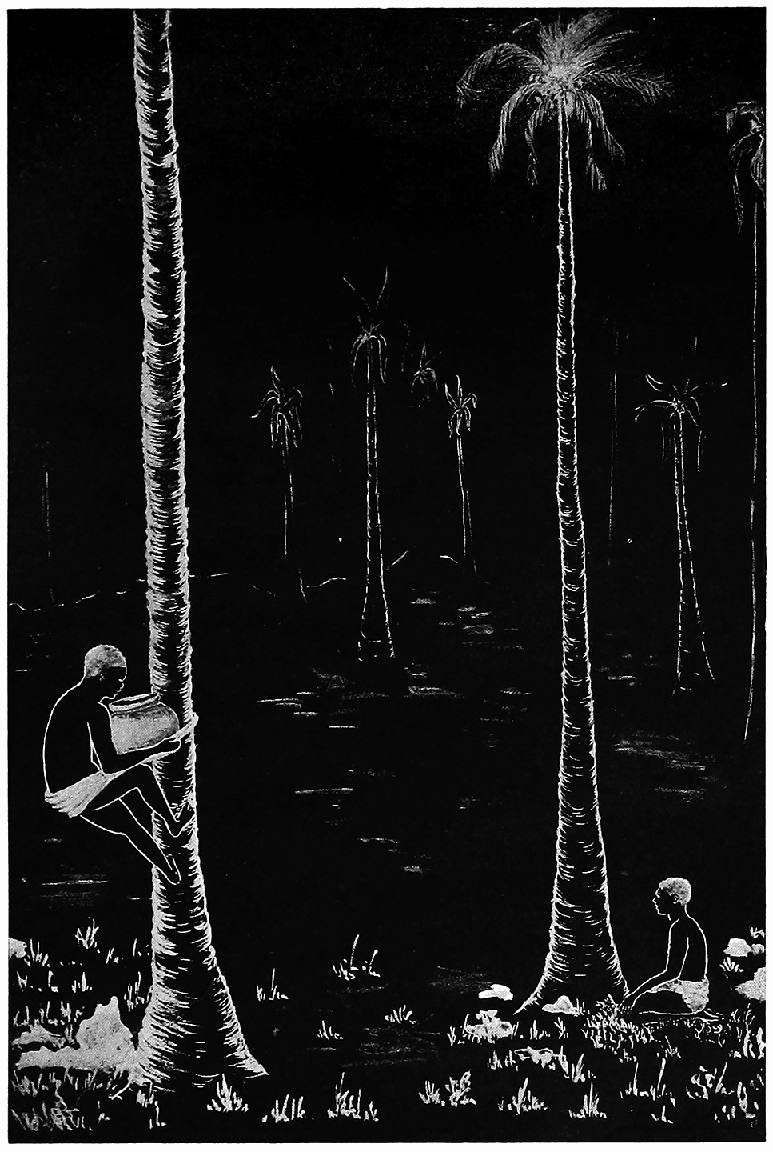
AGAIN AND AGAIN ANANSI TRIED TO CLIMB THE TREE
For some time Kweku Tsin watched his father’s vain attempts. At last, unable to contain himself any longer, he cried out: “Father, why do you not hang the pot on your back? Then you could easily climb the tree.”
Father Anansi turned and said: “I thought I had all the world’s wisdom in this pot. But I find you possess more than I do. All my wisdom was insufficient to show me what to do, yet you have been able to tell me.” In his anger he threw the pot down. It struck on a great rock and broke. The wisdom contained in it escaped and spread throughout the world.
Anansi and Nothing
Near Anansi’s miserable little hut there was a fine palace where lived a very rich man called Nothing. Nothing and Anansi proposed, one day, to go to the neighbouring town to get some wives. Accordingly, they set off together.
Nothing, being a rich man, wore a very fine velvet cloth, while Anansi had a ragged cotton one. While they were on their way Anansi persuaded Nothing to change clothes for a little while, promising to give back the fine velvet before they reached the town. He delayed doing this, however, first on one pretext, then on another—till they arrived at their destination.
Anansi, being dressed in such a fine garment, found no difficulty in getting as many wives as he wished. Poor Nothing, with his ragged and miserable cloth, was treated with great contempt. At first he could not get even one wife. At last, however, a woman took pity on him and gave him her daughter. The poor girl was laughed at very heartily by Anansi’s [36]wives for choosing such a beggar as Nothing appeared to be. She wisely took no notice of their scorn.
The party set off for home. When they reached the cross-roads leading to their respective houses the women were astonished. The road leading to Anansi’s house was only half cleared. The one which led to Nothing’s palace was, of course, wide and well made. Not only so, but his servants had strewn it with beautiful skins and carpets, in preparation for his return. Servants were there, awaiting him, with fine clothes for himself and his wife. No one was waiting for Anansi.
Nothing’s wife was queen over the whole district and had everything her heart could desire. Anansi’s wives could not even get proper food; they had to live on unripe bananas with peppers. The wife of Nothing heard of her friends’ miserable state and invited them to a great feast in her palace. They came, and were so pleased with all they saw that they agreed to stay there. Accordingly, they refused to come back to Anansi’s hut.
He was very angry, and tried in many ways to kill Nothing, but without success. Finally, however, he persuaded some rat friends to dig a deep tunnel [37]in front of Nothing’s door. When the hole was finished Anansi lined it with knives and broken bottles. He then smeared the steps of the palace with okro to make them very slippery, and withdrew to a little distance.
When he thought Nothing’s household was safely in bed and asleep, he called to Nothing to come out to the courtyard and see something. Nothing’s wife, however, dissuaded him from going. Anansi tried again and again, and each time she bade her husband not to listen. At last Nothing determined to go and see this thing. As he placed his foot on the first step, of course he slipped, and down he fell into the hole. The noise alarmed the household. Lights were fetched and Nothing was found in the ditch, so much wounded by the knives that he soon died. His wife was terribly grieved at his untimely death. She boiled many yams, mashed them, and took a great dishful of them round the district. To every child she met she gave some, so that the child might help her to cry for her husband. This is why, if you find a child crying and ask the cause, you will often be told he is “crying for nothing.”
Thunder and Anansi
There had been a long and severe famine in the land where Anansi lived. He had been quite unable to obtain food for his poor wife and family. One day, gazing desperately out to sea, he saw, rising from the midst of the water, a tiny island with a tall palm-tree upon it. He determined to reach this tree—if any means proved possible—and climb it, in the hope of finding a few nuts to reward him. How to get there was the difficulty.
This, however, solved itself when he reached the beach, for there lay the means to his hand, in the shape of an old broken boat. It certainly did not look very strong, but Anansi decided to try it.
His first six attempts were unsuccessful—a great wave dashed him back on the beach each time he tried to put off. He was persevering, however, and at the seventh trial was successful in getting away. He steered the battered old boat as best he could, and at length reached the palm-tree of his desire. Having [40]tied the boat to the trunk of the tree—which grew almost straight out of the water—he climbed toward the nuts. Plucking all he could reach, he dropped them, one by one, down to the boat. To his dismay, every one missed the boat and fell, instead, into the water until only the last one remained. This he aimed even more carefully than the others, but it also fell into the water and disappeared from his hungry eyes. He had not tasted even one and now all were gone.
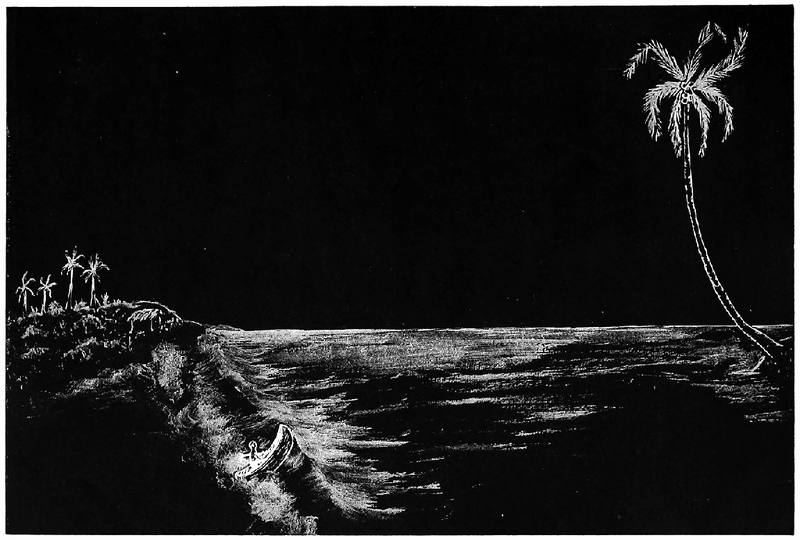
A GREAT WAVE DASHED ANANSI BACK ON THE BEACH
He could not bear the thought of going home empty-handed, so, in his despair, he threw himself into the water, too. To his complete astonishment, instead of being drowned, he found himself standing on the sea-bottom in front of a pretty little cottage. From the latter came an old man, who asked Anansi what he wanted so badly that he had come to Thunder’s cottage to seek it. Anansi told his tale of woe, and Thunder showed himself most sympathetic.
He went into the cottage and fetched a fine cooking-pot, which he presented to Anansi—telling him that he need never be hungry again. The pot would always supply enough food for himself and [41]his family. Anansi was most grateful, and left Thunder with many thanks.
Being anxious to test the pot at once, Anansi only waited till he was again seated in the old boat to say, “Pot, pot, what you used to do for your master do now for me.” Immediately good food of all sorts appeared. Anansi ate a hearty meal, which he very much enjoyed.
On reaching land again, his first thought was to run home and give all his family a good meal from his wonderful pot. A selfish, greedy fear prevented him. “What if I should use up all the magic of the pot on them, and have nothing more left for myself! Better keep the pot a secret—then I can enjoy a meal when I want one.” So, his mind full of this thought, he hid the pot.
He reached home, pretending to be utterly worn out with fatigue and hunger. There was not a grain of food to be had anywhere. His wife and poor children were weak with want of it, but selfish Anansi took no notice of that. He congratulated himself at the thought of his magic pot, now safely hidden in his room. There he retired from time to time when he felt hungry, and enjoyed a good meal. His [42]family got thinner and thinner, but he grew plumper and plumper. They began to suspect some secret, and determined to find it out. His eldest son, Kweku Tsin, had the power of changing himself into any shape he chose; so he took the form of a tiny fly, and accompanied his father everywhere. At last, Anansi, feeling hungry, entered his room and closed the door. Next he took the pot, and had a fine meal. Having replaced the pot in its hiding-place, he went out, on the pretence of looking for food.
As soon as he was safely out of sight, Kweku Tsin fetched out the pot and called all his hungry family to come at once. They had as good a meal as their father had had. When they had finished, Mrs. Anansi—to punish her husband—said she would take the pot down to the village and give everybody a meal. This she did—but alas! in working to prepare so much food at one time, the pot grew too hot and melted away. What was to be done now? Anansi would be so angry! His wife forbade every one to mention the pot.
Anansi returned, ready for his supper, and, as usual, went into his room, carefully shutting the door. He went to the hiding-place—it was empty! [43]He looked around in consternation. No pot was to be seen anywhere. Some one must have discovered it. His family must be the culprits; he would find a means to punish them.
Saying nothing to any one about the matter, he waited till morning. As soon as it was light he started off towards the shore, where the old boat lay. Getting into the boat, it started of its own accord and glided swiftly over the water—straight for the palm-tree. Arrived there, Anansi attached the boat as before and climbed the tree. This time, unlike the last, the nuts almost fell into his hands. When he aimed them at the boat they fell easily into it—not one, as before, dropping into the water. He deliberately took them and threw them overboard, immediately jumping after them. As before, he found himself in front of Thunder’s cottage, with Thunder waiting to hear his tale. This he told, the old man showing the same sympathy as he had previously done.
This time, however, he presented Anansi with a fine stick and bade him good-bye. Anansi could scarcely wait till he got into the boat—so anxious was he to try the magic properties of his new gift. [44]“Stick, stick,” he said, “what you used to do for your master do for me also.” The stick began to beat him so severely that, in a few minutes, he was obliged to jump into the water and swim ashore, leaving boat and stick to drift away where they pleased. Then he returned sorrowfully homeward, bemoaning his many bruises and wishing he had acted more wisely from the beginning.
Tit for Tat
There had been a great famine in the land for many months. Meat had become so scarce that only the rich chiefs had money enough to buy it. The poor people were starving. Anansi and his family were in a miserable state.
One day, Anansi’s eldest son—Kweku Tsin—to his great joy, discovered a place in the forest where there were still many animals. Knowing his father’s wicked ways, Kweku told him nothing of the matter. Anansi, however, speedily discovered that Kweku was returning loaded, day after day, to the village. There he was able to sell the meat at a good price to the hungry villagers. Anansi immediately wanted to know the secret—but his son wisely refused to tell him. The old man determined to find out by a trick.
Slipping into his son’s room one night, when he was fast asleep, he cut a tiny hole in the corner of the bag which Kweku always carried into the forest. [52]Anansi then put a quantity of ashes into the bag and replaced it where he had found it.
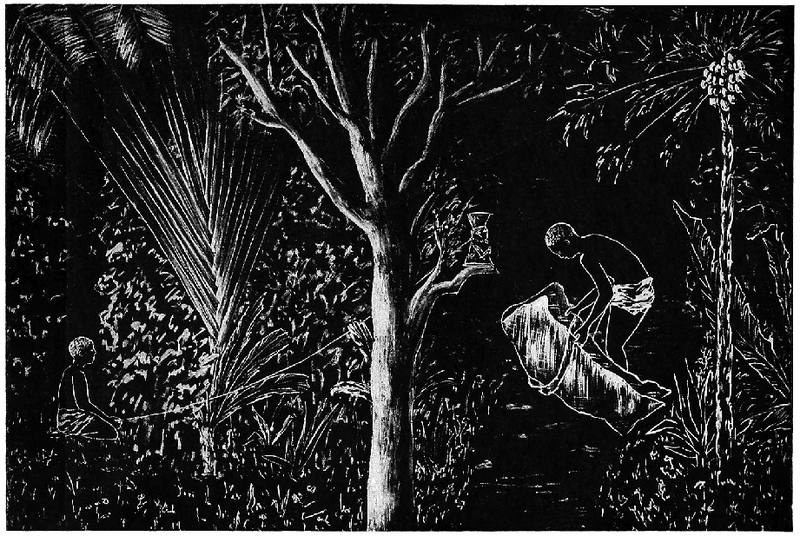
“MAY I GIVE YOU A LITTLE OF THIS MEAT?”
Next morning, as Kweku set out for the forest, he threw the bag, as usual, over his shoulder. Unknown to him, at each step, the ashes were sprinkled on the ground. Consequently, when Anansi set out an hour later he was easily able to follow his son by means of the trail of ashes. He, too, arrived at the animals’ home in the forest, and found Kweku there before him. He immediately drove his son away, saying that, by the law of the land, the place belonged to him. Kweku saw how he had been tricked, and determined to have the meat back.
He accordingly went home—made a tiny image and hung little bells round its neck. He then tied a long thread to its head and returned toward the hunting-place.
When about half-way there, he hung the image to a branch of a tree in the path, and hid himself in the bushes near by—holding the other end of the thread in his hand.
The greedy father, in the meantime, had killed as many animals as he could find, being determined to become rich as speedily as possible. He then skinned [53]them and prepared the flesh—to carry it to the neighbouring villages to sell. Taking the first load, he set off for his own village. Half-way there, he came to the place where the image hung in the way. Thinking this was one of the gods, he stopped. As he approached, the image began to shake its head vigorously at him. He felt that this meant that the gods were angry. To please them, he said to the image, “May I give you a little of this meat?” Again the image shook its head. “May I give you half of this meat?” he then inquired. The head shook once more. “Do you want the whole of this meat?” he shouted fiercely. This time the head nodded, as if the image were well pleased. “I will not give you all my meat,” Anansi cried. At this the image shook in every limb as if in a terrible temper. Anansi was so frightened that he threw the whole load on the ground and ran away. As he ran, he called back, “To-morrow I shall go to Ekubon—you will not be able to take my meat from me there, you thief.”
But Kweku had heard where his father intended to go next day—and set the image in his path as before. Again Anansi was obliged to leave his [54]whole load—and again he called out the name of the place where he would go the following day.
The same thing occurred, day after day, till all the animals in the wood were killed. By this time, Kweku Tsin had become very rich—but his father Anansi was still very poor. He was obliged to go to Kweku’s house every day for food.
When the famine was over, Kweku gave a great feast and invited the entire village. While all were gathered together, Kweku told the story of his father’s cunning and how it had been overcome. This caused great merriment among the villagers. Anansi was so ashamed that he readily promised Kweku to refrain from his evil tricks for the future. This promise, however, he did not long keep.
The Squirrel and the Spider
A hard-working squirrel had, after much labour, succeeded in cultivating a very fine farm. Being a skilful climber of trees, he had not troubled to make a roadway into his farm. He used to reach it by the trees.
One day, when his harvests were very nearly ripe, it happened that Spider went out hunting in that neighbourhood. During his travels, he arrived at Squirrel’s farm. Greatly pleased at the appearance of the fields, he sought for the roadway to it. Finding none, he returned home and told his family all about the matter. The very next day they all set out for this fine place, and set to work immediately to make a road. When this was completed Spider—who was very cunning—threw pieces of earthenware pot along the pathway. This he did to make believe that his children had dropped them while working to prepare the farm.
Then he and his family began to cut down and carry away such of the corn as was ripe. Squirrel noticed that his fields were being robbed, but could not at first find the thief. He determined to watch. Sure enough Spider soon reappeared to steal more of the harvest. Squirrel demanded to know what right he had on these fields. Spider immediately asked him the same question. “They are my fields,” said Squirrel. “Oh, no! They are mine,” retorted Spider. “I dug them and sowed them and planted them,” said poor Squirrel. “Then where is your roadway to them?” said crafty Spider. “I need no roadway. I come by the trees,” was Squirrel’s reply. Needless to say, Spider laughed such an answer to scorn, and continued to use the farm as his own.
Squirrel appealed to the law, but the court decided that no one had ever had a farm without a road leading to it, therefore the fields must be Spider’s.
In great glee Spider and his family prepared to cut down all the harvest that remained. When it was cut they tied it in great bundles and set off to the nearest market-place to sell it. When they were about half-way there, a terrible storm came on. They were [61]obliged to put down their burdens by the roadside and run for shelter. When the storm had passed they returned to pick up their loads.
As they approached the spot they found a great, black crow there, with his broad wings outspread to keep the bundles dry. Spider went to him and very politely thanked him for so kindly taking care of their property. “Your property!” replied Father Crow. “Who ever heard of any one leaving bundles of corn by the roadside? Nonsense! These loads are mine.” So saying, he picked them up and went off with them, leaving Spider and his children to return home sorrowful and empty-handed. Their thieving ways had brought them little profit.
Anansi the Blind Fisherman
Anansi, in his old age, became a fisherman. Very soon after that his sight began to fail. Finally, he grew quite blind. However, still being very strong, he continued his fishing—with the help of two men. The latter were exceedingly kind to him, and aided him in every possible way. They led him, each morning, to the beach and into the canoe. They told him where to spread his net and when to pull it in. When they returned to land they told him just where and when to step out, so that he did not even get wet.
Day after day this went on, but Anansi—instead of being in the least grateful to them—behaved very badly. When they told him where to spread his net, he would reply sharply, “I know. I was just about to put it there.” When they were directing him to get out of the boat, he would say, “Oh, I know perfectly well we are at the beach. I was just getting ready to step out.”
This went on for a long time, Anansi getting ruder and ruder to his helpers every day, until they could bear his treatment no longer. They determined when opportunity offered to punish him for his ingratitude.
The next day, as usual, he came with them to the beach. When they had got the canoe ready, they bade him step in. “Do you think I am a fool?” said he. “I know the canoe is there.” They made no answer, but got in and patiently pulled toward the fishing-place. When they told him where to spread his net, he replied with so much abuse that they determined, there and then, to punish him.
By this time the canoe was full of fish, so they turned to row home. When they had gone a little way they stopped and said to him, “Here we are at the beach.” He promptly told them that they were very foolish—to tell him a thing he knew so well. He added many rude and insulting remarks, which made them thoroughly angry. He then jumped proudly out, expecting to land on the beach. To his great astonishment he found himself sinking in deep water. The two men rowed quickly away, leaving him to struggle.
Like all the men of that country he was a good swimmer, but, of course, being blind, he was unable to see where the land lay. So he swam until he was completely tired out—and was drowned.