 Curio Class
Wigwam Evenings: Sioux folk tales (set I)
Charles A. Eastman and Elaine Goodale Eastman
The Buffalo and the Field-Mouse
The cold December moon is just showing above the tree-tops, pointing a white finger here and there at the clustered teepees of the Sioux, while opposite their winter camp on the lake shore a lonely, wooded island is spread like a black buffalo robe between the white, snow-covered ice and the dull gray sky.
All by itself at the further end of the village stands the teepee of Smoky Day, the old story-teller, the school-master of the woods. The paths that lead to this low brown wigwam are well beaten; deep, narrow trails, like sheep paths, in the hard-frozen snow.
To-night a generous fire of logs gives both warmth and light inside the teepee, and the old man is calmly filling his long, red pipe for the smoke of meditation, when the voices and foot-steps of several children are distinctly heard through the stillness of the winter night.
The door-flap is raised, and the nine-year-old Tanagela, the Humming-bird, slips in first, with her roguish black eyes and her shy smile.
"Grandmother, we have come to hear a story," she murmurs. "I have brought you a sun-dried buffalo-tongue, grandmother!"
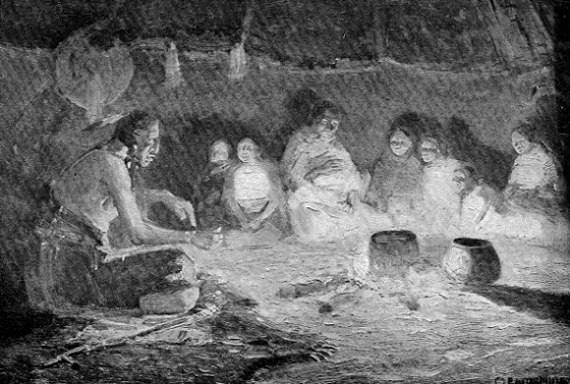
Page 5 SMOKY DAY TELLING TALES OF OLD DAYS AROUND HIS FIRE.
One by one the little people of the village follow her, and all seat themselves on the ground about the central fire until the circle is well filled. Then the old man lays down his pipe, clears his throat once or twice and begins in a serious voice:
"These old stories for which you ask teach us the way of life, my grandchildren. The Great-Grandfather of all made us all; therefore we are brothers.
"In many of the stories the people have a common language, which now the Great Mystery has taken away from us, and has put a barrier between us and them, so that we can no longer converse together and understand the speech of the animal people.
"Observe, further, that silence is greater than speech. This is why we honor the animals, who are more silent than man, and we reverence the trees and rocks, where the Great Mystery lives undisturbed, in a peace that is never broken.
"Let no one ask a question until the story is finished."
THE BUFFALO AND THE FIELD-MOUSE
Once upon a time, when the Field-Mouse was out gathering wild beans for the winter, his neighbor, the Buffalo, came down to graze in the meadow. This the little Mouse did not like, for he knew that the other would mow down all the long grass with his prickly tongue, and there would be no place in which to hide. He made up his mind to offer battle like a man.
"Ho, Friend Buffalo, I challenge you to a fight!" he exclaimed in a small, squeaking voice.
The Buffalo paid no attention, no doubt thinking it only a joke. The Mouse angrily repeated the challenge, and still his enemy went on quietly grazing. Then the little Mouse laughed with contempt as he offered his defiance. The Buffalo at last looked at him and replied carelessly:
"You had better keep still, little one, or I shall come over there and step on you, and there will be nothing left!"
"You can't do it!" replied the Mouse.
"I tell you to keep still," insisted the Buffalo, who was getting angry. "If you speak to me again, I shall certainly come and put an end to you!"
"I dare you to do it!" said the Mouse, provoking him.
Thereupon the other rushed upon him. He trampled the grass clumsily and tore up the earth with his front hoofs. When he had ended, he looked for the Mouse, but he could not see him anywhere.
"I told you I would step on you, and there would be nothing left!" he muttered.
Just then he felt a scratching inside his right ear. He shook his head as hard as he could, and twitched his ears back and forth. The gnawing went deeper and deeper until he was half wild with the pain. He pawed with his hoofs and tore up the sod with his horns. Bellowing madly, he ran as fast as he could, first straight forward and then in circles, but at last he stopped and stood trembling. Then the Mouse jumped out of his ear, and said:
"Will you own now that I am master?"
"No!" bellowed the Buffalo, and again he started toward the Mouse, as if to trample him under his feet. The little fellow was nowhere to be seen, but in a minute the Buffalo felt him in the other ear. Once more he became wild with pain, and ran here and there over the prairie, at times leaping high in the air. At last he fell to the ground and lay quite still. The Mouse came out of his ear, and stood proudly upon his dead body.
"Eho!" said he, "I have killed the greatest of all beasts. This will show to all that I am master!"
Standing upon the body of the dead Buffalo, he called loudly for a knife with which to dress his game.
In another part of the meadow, Red Fox, very hungry, was hunting mice for his breakfast. He saw one and jumped upon him with all four feet, but the little Mouse got away, and he was dreadfully disappointed.
All at once he thought he heard a distant call: "Bring a knife! Bring a knife!"
When the second call came, Red Fox started in the direction of the sound. At the first knoll he stopped and listened, but hearing nothing more, he was about to go back. Just then he heard the call plainly, but in a very thin voice, "Bring a knife!" Red Fox immediately set out again and ran as fast as he could.
By and by he came upon the huge body of the Buffalo lying upon the ground. The little Mouse still stood upon the body.
"I want you to dress this Buffalo for me and I will give you some of the meat," commanded the Mouse.
"Thank you, my friend, I shall be glad to do this for you," he replied, politely.
The Fox dressed the Buffalo, while the Mouse sat upon a mound near by, looking on and giving his orders. "You must cut the meat into small pieces," he said to the Fox. When the Fox had finished his work, the Mouse paid him with a small piece of liver. He swallowed it quickly and smacked his lips.
"Please, may I have another piece?" he asked quite humbly.
"Why, I gave you a very large piece! How greedy you are!" exclaimed the Mouse. "You may have some of the blood clots," he sneered. So the poor Fox took the blood clots and even licked off the grass. He was really very hungry.
"Please may I take home a piece of the meat?" he begged. "I have six little folks at home, and there is nothing for them to eat."
"You can take the four feet of the Buffalo. That ought to be enough for all of you!"
"Hi, hi! Thank you, thank you!" said the Fox. "But, Mouse, I have a wife also, and we have had bad luck in hunting. We are almost starved. Can't you spare me a little more?"
"Why," declared the Mouse, "I have already overpaid you for the little work you have done. However, you can take the head, too!"
Thereupon the Fox jumped upon the Mouse, who gave one faint squeak and disappeared.
If you are proud and selfish you will lose all in the end.
The Frogs and the Crane
Again the story-hour is come, and the good old wife of the legend-teller has made her poor home as warm and pleasant as may be, in expectation of their guests. She is proud of her husband's honorable position as the village teacher, and makes all the children welcome, as they arrive, with her shrill-voiced, cheerful greeting:
"Han, han; sit down, sit down; that is right, that is very right, my grandchild!"
To-night the Humming-bird has come leading by the hand her small brother, who stumbles along in his fringed, leathern leggings and handsomely beaded moccasins, his chubby, solemn face finished off with two long, black braids tied with strips of otter-skin. As he is inclined to be restless and to talk out of season, she keeps him close beside her.
"It is cold to-night!" he pipes up suddenly when all is quiet. "Why do we not listen to these stories in the warm summer-time, elder sister?"
"Hush, my little brother!" Tanagela reproves him with a frightened look. "Have you never heard that if the old stories are told in summer, the snakes will creep into our beds?" she whispers fearfully.
"That is true, my granddaughter," assents the old man. "Yet we may tell a legend of summer days to comfort the heart of the small brother!"
THE FROGS AND THE CRANE
In the heart of the woods there lay a cool, green pond. The shores of the pond were set with ranks of tall bulrushes that waved crisply in the wind, and in the shallow bays there were fleets of broad water lily leaves. Among the rushes and reeds and in the quiet water there dwelt a large tribe of Frogs.
On every warm night of spring, the voices of the Frogs arose in a cheerful chorus. Some voices were low and deep—these were the oldest and wisest of the Frogs; at least, they were old enough to have learned wisdom. Some were high and shrill, and these were the voices of the little Frogs who did not like to be reminded of the days when they had tails and no legs.
"Kerrump! kerrump! I'm chief of this pond!" croaked a very large bullfrog, sitting in the shade of a water lily leaf.
"Kerrump! kerrump! I'm chief of this pond!" replied a hoarse voice from the opposite bank.
"Kerrump! kerrump! I'm chief of this pond!" boasted a third old Frog from the furthest shore of the pond.
Now a long-legged white Crane was standing near by, well hidden by the coarse grass that grew at the water's edge. He was very hungry that evening, and when he heard the deep voice of the first Bullfrog he stepped briskly up to him and made a quick pass under the broad leaf with his long, cruel bill. The old Frog gave a frightened croak, and kicked violently in his efforts to get away, while over the quiet pond, splash! splash! went the startled little Frogs into deep water.
The Crane almost had him, when something cold and slimy wound itself about one of his legs. He drew back for a second, and the Frog got safely away! But the Crane did not lose his dinner after all, for about his leg was curled a large black water snake, and that made a fair meal.
Now he rested awhile on one leg, and listened. The first Frog was silent, but from the opposite bank the second Frog croaked boastfully:
"Kerrump! kerrump! I'm chief of this pond!"
The Crane began to be hungry again. He went round the pond without making any noise, and pounced upon the second Frog, who was sitting up in plain sight, swelling his chest with pride, for he really thought now that he was the sole chief of the pond.
The Crane's head and most of his long neck disappeared under the water, and all over the pond the little Frogs went splash! splash! into the deepest holes to be out of the way.
Just as he had the Frog by one hind leg, the Crane saw something that made him let go, flap his broad wings and fly awkwardly away to the furthest shore. It was a mink, with his slender brown body and wicked eyes, and he had crept very close to the Crane, hoping to seize him at his meal! So the second Frog got away too; but he was so dreadfully frightened that he never spoke again.
After a long time the Crane got over his fright and he became very hungry once more. The pond had been still so long that many of the Frogs were singing their pleasant chorus, and above them all there boomed the deep voice of the third and last Bullfrog, saying:
"Kerrump! kerrump! I'm chief of this pond!"
The Crane stood not far from the boaster, and he determined to silence him once for all. The next time he began to speak, he had barely said "Kerrump!" when the Crane had him by the leg. He croaked and struggled in vain, and in another moment he would have gone down the Crane's long throat.
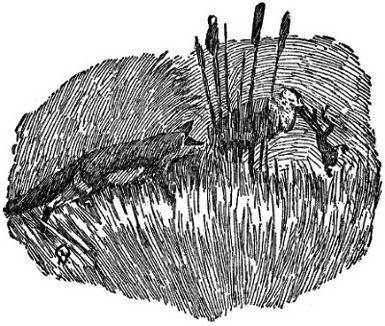
But just then a Fox crept up behind the Crane and seized him! The Crane let go the Frog and was carried off screaming into the woods for the Fox's supper. So the third Frog got away; but he was badly lamed by the Crane's strong bill, and he never dared to open his mouth again.
It is not a wise thing to boast too loudly.
The Eagle and the Beaver
"No, elder sister, it is not for a hunter and a brave to fetch wood for the lodge fire! That is woman's task, and it is not right that you should ask it of me."
"But see, my younger brother, you are only a small boy and can neither hunt nor fight; surely, therefore, it is well for you to help our mother at home!"
The two children, Wasula and Chatanna, as they draw near the old story-teller's wigwam, are carrying on a dispute that has arisen between them earlier in the evening, when dry sticks were to be gathered for cooking the supper, and Chatanna, aged seven, refused to help his sister on the ground that it is not a warrior's duty to provide wood. Both appeal to their teacher to settle the question.
"Hun, hun, hay!" good-naturedly exclaims the old man. "Truly, there is much to be said on both sides; but perhaps you can agree more easily after you have heard my story."
THE EAGLE AND THE BEAVER
Out of the quiet blue sky there shot like an arrow the great War-eagle. Beside the clear brown stream an old Beaver-woman was busily chopping wood. Yet she was not too busy to catch the whir of descending wings, and the Eagle reached too late the spot where she had vanished in the midst of the shining pool.
He perched sullenly upon a dead tree near by and kept his eyes steadily upon the smooth sheet of water above the dam.
After a time the water was gently stirred and a sleek, brown head cautiously appeared above it.
"What right have you," reproached the Beaver-woman, "to disturb thus the mother of a peaceful and hard-working people?"
"Ugh, I am hungry," the Eagle replied shortly.
"Then why not do as we do—let other folks alone and work for a living?"
"That is all very well for you," the Eagle retorted, "but not everybody can cut down trees with his teeth, or live upon bark and weeds in a mud-plastered wigwam. I am a warrior, not an old woman!"
"It is true that some people are born trouble-makers," returned the Beaver, quietly. "Yet I see no good reason why you, as well as we, should not be content with plain fare and willing to toil for what you want. My work, moreover, is of use to others besides myself and family, for with my dam-building I deepen the stream for the use of all the dwellers therein, while you are a terror to all living creatures that are weaker than yourself. You would do well to profit by my example."
So saying, she dove down again to the bottom of the pool.
The Eagle waited patiently for a long time, but he saw nothing more of her; and so, in spite of his contempt for the harmless industry of an old Beaver-woman, it was he, not she, who was obliged to go hungry that morning.
Pride alone will not fill the stomach.
The Raccoon and the Bee-Tree
"Ho, Chatanna," says the old story-teller, pleasantly, "I see that you have brought Mato, the Bear, with you to-night! I hope he will be good and not disturb the other scholars."
"Grandfather," says Chatanna, earnestly, "he will be good. He obeys me, and is never troublesome like some pets. He will lie quietly here by me and listen to the story!"
All the children range themselves around the brightly burning fire, the little boys sitting cross-legged, and the girls sideways, like demure little women.
Although they do not know it yet, there is a special treat in store for them all this evening. The story is one in which feasting plays a part, and whenever good things to eat come into a story, it is a pleasant custom of the Sioux to offer some delicacy.
The good old wife of the teacher has prepared a kettle full of her choicest wild rice, dark in color but of a flavor to be remembered, and a generous dish of boiled rice sprinkled with maple-sugar is passed to each child, (and doubtless shared with Mato by his loving friend,) at the close of the story about
THE RACCOON AND THE BEE-TREE
The Raccoon had been asleep all day in the snug hollow of a tree. The dusk was coming on when he awoke, stretched himself once or twice, and jumping down from the top of the tall, dead stump in which he made his home, set out to look for his supper.
In the midst of the woods there was a lake, and all along the lake shore there rang out the alarm cries of the water people as the Raccoon came nearer and nearer.
First the Swan gave a scream of warning. The Crane repeated the cry, and from the very middle of the lake the Loon, swimming low, took it up and echoed it back over the still water.
The Raccoon sped merrily on, and finding no unwary bird that he could seize he picked up a few mussel-shells from the beach, cracked them neatly and ate the sweet meat.
A little further on, as he was leaping hither and thither through the long, tangled meadow grass, he landed with all four feet on a family of Skunks—father, mother and twelve little ones, who were curled up sound asleep in a soft bed of broken dry grass.
"Huh!" exclaimed the father Skunk. "What do you mean by this, eh?" And he stood looking at him defiantly.
"Oh, excuse me, excuse me," begged the Raccoon. "I am very sorry. I did not mean to do it! I was just running along and I did not see you at all."
"Better be careful where you step next time," grumbled the Skunk, and the Raccoon was glad to hurry on.
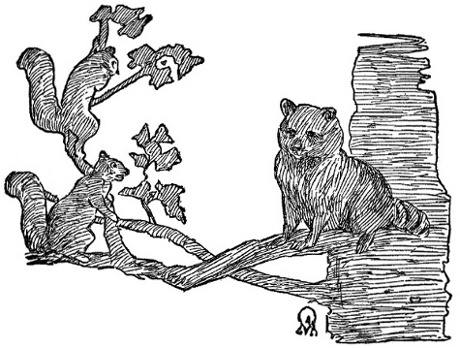
Running up a tall tree he came upon two red Squirrels in one nest, but before he could get his paws upon one of them they were scolding angrily from the topmost bough.
"Come down, friends!" called the Raccoon. "What are you doing up there? Why, I wouldn't harm you for anything!"
"Ugh, you can't fool us," chattered the Squirrels, and the Raccoon went on.
Deep in the woods, at last, he found a great hollow tree which attracted him by a peculiar sweet smell. He sniffed and sniffed, and went round and round till he saw something trickling down a narrow crevice. He tasted it and it was deliciously sweet.
He ran up the tree and down again, and at last found an opening into which he could thrust his paw. He brought it out covered with honey!
Now the Raccoon was happy. He ate and scooped, and scooped and ate the golden, trickling honey with both forepaws till his pretty, pointed face was daubed all over.
Suddenly he tried to get a paw into his ear. Something hurt him terribly just then, and the next minute his sensitive nose was frightfully stung. He rubbed his face with both sticky paws. The sharp stings came thicker and faster, and he wildly clawed the air. At last he forgot to hold on to the branch any longer, and with a screech he tumbled to the ground.
There he rolled and rolled on the dead leaves till he was covered with leaves from head to foot, for they stuck to his fine, sticky fur, and most of all they covered his eyes and his striped face. Mad with fright and pain he dashed through the forest calling to some one of his own kind to come to his aid.
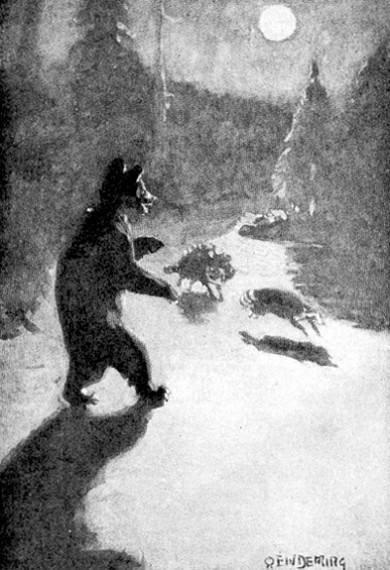
SO THEY RAN AND THEY RAN OUT OF THE WOODS ON TO THE SHINING WHITE BEACH.
The moon was now bright, and many of the woods people were abroad. A second Raccoon heard the call and went to meet it. But when he saw a frightful object plastered with dry leaves racing madly toward him he turned and ran for his life, for he did not know what this thing might be.
The Raccoon who had been stealing the honey ran after him as fast as he could, hoping to overtake and beg the other to help him get rid of his leaves.
So they ran and they ran out of the woods on to the shining white beach around the lake. Here a Fox met them, but after one look at the queer object which was chasing the frightened Raccoon he too turned and ran at his best speed.
Presently a young Bear came loping out of the wood and sat up on his haunches to see them go by. But when he got a good look at the Raccoon who was plastered with dead leaves, he scrambled up a tree to be out of the way.
By this time the poor Raccoon was so frantic that he scarcely knew what he was doing. He ran up the tree after the Bear and got hold of his tail.
"Woo, woo!" snarled the Bear, and the Raccoon let go. He was tired out and dreadfully ashamed. He did now what he ought to have done at the very first—he jumped into the lake and washed off most of the leaves. Then he got back to his hollow tree and curled himself up and licked and licked his soft fur till he had licked himself clean, and then he went to sleep.
The midnight hunter steals at his own risk.