Rational Exponents and Real Numbers
Grade 9 · Extend exponents to rational values; properties of rational and irrational numbers
 Curio Class
Tools that work like the real thing: simulators, data and models that students run and question. 209 tools across 12 subjects.

Spin a 3D atom, light up its emission spectrum and wander the whole periodic table. No quiz, just curiosity.
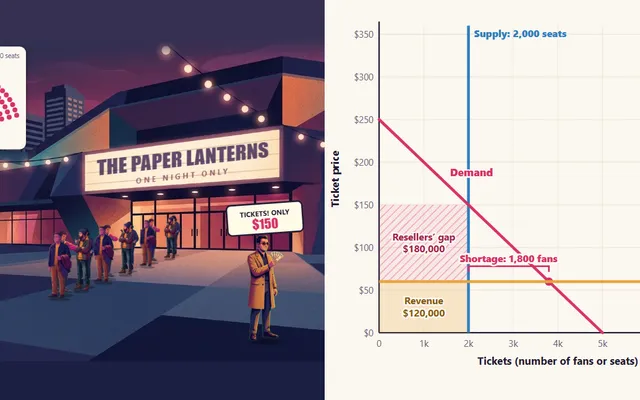
Set the ticket price and watch the line, the empty seats and the resellers. Then take the show on tour and find each city's price from the sales.
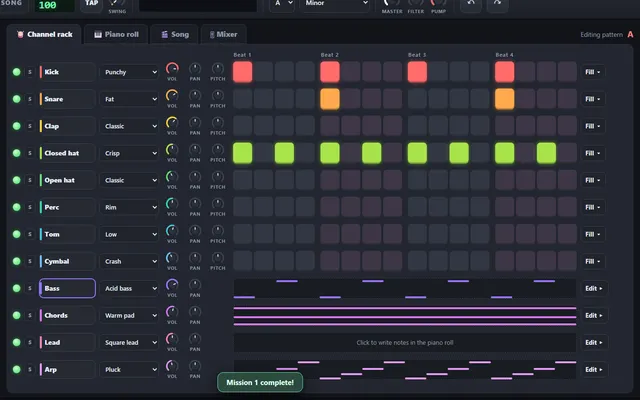
A full step-sequencer studio in one file: 214 sounds and 10 drum kits, 30 instruments, your own samples, a piano roll, a song playlist and a mixer with sidechain pump and a DJ filter. Export your track as a WAV.
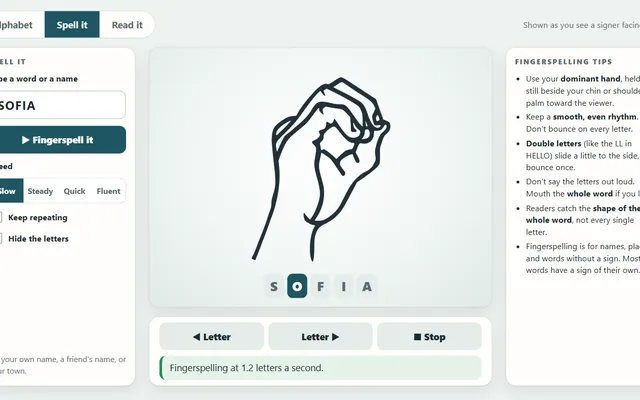
All 26 handshapes of the ASL manual alphabet, any word or name fingerspelled at the speed you pick, and a reading game that speeds up every time you get one right.
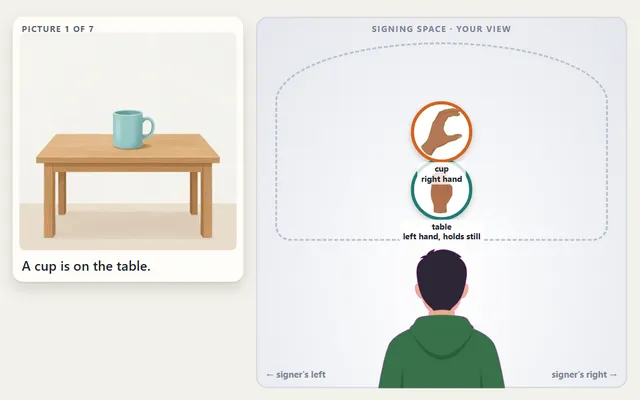
Set up twenty pictures the way ASL does: decide what stays still, choose a classifier handshape for each object, then place and move them in signing space and flip to the viewer's view.
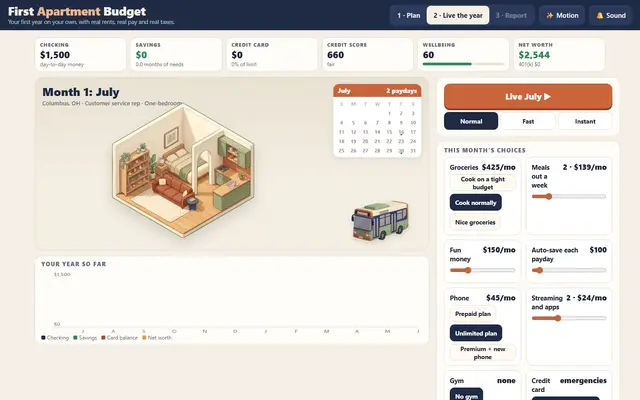
Pick a real city, a real starting job and a place to live, then survive twelve months on your own: paychecks under 2026 tax rules, surprise bills, roommates, a credit card and a year-end report card. Class codes give everyone the same year.
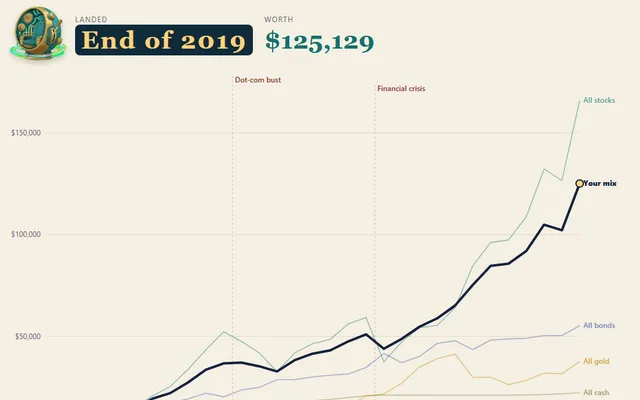
Travel to any year from 1928 and ride real returns forward with your mix of stocks, bonds, cash and gold. See what time, inflation, fees and a bad start year really do. Educational only, not advice.
Nothing here is built yet. Everything on this page is still on the bench.
Grade 9 · Extend exponents to rational values; properties of rational and irrational numbers
Grade 9 · Reason quantitatively and use units to solve problems
Grade 9 · Interpret and rewrite expressions; factor and complete the square
Grade 9 · Add, subtract and multiply polynomials
Grade 9 · Create equations and inequalities that describe relationships
Grade 9 · Solve equations and inequalities in one variable
Grade 9 · Solve systems algebraically and graphically
Grade 9 · Domain, range, key features and rate of change
Grade 9 · Compare and build models; transformations of graphs
Grade 9 · Solve quadratics by factoring, completing the square and formula
Grade 9 · Distributions, scatter plots, residuals and correlation
Grade 10 · Transformations as functions; triangle congruence
Grade 10 · Prove theorems about lines, angles, triangles and parallelograms; constructions
Grade 10 · Dilations and similar triangles
Grade 10 · Sine, cosine, tangent and solving right triangles
Grade 10 · Arcs, angles, chords, tangents, sectors and radians
Grade 10 · Equations of conics; prove properties with coordinates
Grade 10 · Volume formulas; 2D cross sections and solids of rotation
Grade 10 · Apply geometric concepts to real situations and design
Grade 10 · Independence, conditional probability and the addition rule
Grade 11 · Operations with complex numbers; complex solutions to quadratics
Grade 11 · Remainder theorem, zeros and graphs; polynomial identities
Grade 11 · Rewrite rational expressions; extraneous solutions
Grade 11 · Logarithms, growth and decay models
Grade 11 · Unit circle, radian measure and periodic models
Grade 11 · Combine functions; find inverses; transformations
Grade 11 · Arithmetic and geometric sequences; finite geometric series
Grade 11 · Normal distributions, sampling, surveys, experiments and margin of error
Grade 12 · Families of functions, composition, inverses and asymptotes
Grade 12 · Identities, inverse trig and solving equations
Grade 12 · Vector quantities, operations and applications
Grade 12 · Matrix operations and solving systems
Grade 12 · Polar form and graphs; complex numbers in the plane
Grade 12 · Parabolas, ellipses and hyperbolas
Grade 12 · Intuitive limits and average to instantaneous rate
Grade 12 · Describe distributions and relationships
Grade 12 · Design studies; bias; random assignment
Grade 12 · Probability models, expected value, binomial and geometric
Grade 12 · Variation in statistics from sample to sample
Grade 12 · Inference for proportions and means
Grade 12 · Inference for categorical data and slopes
Grade 12 · Limits, continuity and asymptotic behavior
Grade 12 · Derivative as rate of change; rules of differentiation
Grade 12 · Related rates, optimization and curve sketching
Grade 12 · Riemann sums, accumulation and the Fundamental Theorem
Grade 12 · Area, volume and motion
Grade 12 · Slope fields and exponential models
Grade 9 · How characters with conflicting motivations develop theme
Grade 9 · Parallel plots, flashbacks and pacing create tension
Grade 9 · How authors draw on and transform source material, including Shakespeare
Grade 9 · Author's point of view and use of rhetoric
Grade 9 · Foundational documents and their themes
Grade 9 · Precise claims, counterclaims and formal style
Grade 9 · Sustained research, synthesis and citation
Grade 9 · Parallel structure; types of phrases and clauses
Grade 10 · Cultural experience reflected in literature from outside the US
Grade 10 · How word choices shape meaning and tone
Grade 10 · Compare a subject in two artistic mediums
Grade 10 · Validity of reasoning; false statements and fallacies
Grade 10 · Analysis essays supported by textual evidence
Grade 10 · Propel conversations, respond to diverse perspectives
Grade 10 · Advanced punctuation; style guides
Grade 11 · Foundational American works and literary movements
Grade 11 · Distinguish what is directly stated from what is meant
Grade 11 · Analyze 17th-19th century US documents and their premises
Grade 11 · Integrate and evaluate sources in different media
Grade 11 · Synthesize multiple sources; analyze rhetorical strategies
Grade 11 · Narrative writing for real audiences
Grade 11 · Usage conventions can change and be contested
Grade 12 · Shakespeare and major works from British and world traditions
Grade 12 · How structure choices contribute to meaning and aesthetic impact
Grade 12 · Evaluate structure and effectiveness of an author's argument
Grade 12 · Self-generated inquiry with sustained research
Grade 12 · Present a perspective with strategic use of media
Grade 12 · Evaluate sources, bias and persuasion in media
Grade 12 · Etymology, nuance and academic vocabulary
Grade 9 · Organelles, membranes and specialized cells
Grade 9 · Feedback mechanisms maintain stability
Grade 9 · Mitosis and development of complex organisms
Grade 9 · Energy conversions and macromolecules
Grade 9 · DNA structure, transcription and translation
Grade 9 · Meiosis, variation and probability of traits
Grade 9 · Evidence for common ancestry; natural selection and adaptation
Grade 9 · Carrying capacity, energy flow and ecosystem dynamics
Grade 9 · Reduce human impact on ecosystems; group behavior
Grade 9 · Life cycle of stars; origin of the universe and elements
Grade 9 · Kepler's laws; age of Earth and plate history
Grade 9 · Internal and surface processes; feedback loops
Grade 9 · Properties of water shape surface processes
Grade 9 · Energy flow and climate change; carbon cycle
Grade 9 · Natural resources, hazards and sustainable management
Grade 10 · Atomic structure predicts properties; periodic patterns
Grade 10 · Ionic and covalent bonds; structure determines properties
Grade 10 · Predict products; balance equations
Grade 10 · Quantitative relationships in reactions
Grade 10 · Bond energy, exothermic and endothermic reactions
Grade 10 · Collision theory; Le Chatelier's principle
Grade 10 · Gas laws and particle behavior
Grade 10 · pH, neutralization and concentration
Grade 10 · Fission, fusion and radioactive decay
Grade 11 · Position, velocity and acceleration graphs
Grade 11 · Force, mass and acceleration
Grade 11 · Conservation of momentum; design to reduce force
Grade 11 · Newton's and Coulomb's laws
Grade 11 · Conservation of energy; energy conversion devices
Grade 11 · Circuits; electric currents and magnetic fields
Grade 11 · Frequency, wavelength and speed
Grade 11 · Wave-particle model; EM radiation and technology
Grade 12 · Biomes, energy flow and succession
Grade 12 · Human population growth and resource use
Grade 12 · Renewable and nonrenewable energy tradeoffs
Grade 12 · Air, water and land pollution; engineering solutions
Grade 12 · Break down complex problems; evaluate solutions with tradeoffs
Grades 9-12 · Analyze, interpret and evaluate artworks
Grades 9-12 · Advanced spatial drawing and composition
Grades 9-12 · Select, present and curate work
Grades 9-12 · Keys, modulation and analysis
Grades 9-12 · Medieval to contemporary styles
Grades 9-12 · Arrange and produce original music
Grades 9-12 · Theatrical traditions; directing choices
Grades 9-12 · Analyze styles; evaluate performances
Grades 9-12 · Storyboarding, shots and editing
Grades 9-12 · Typography, layout and branding
Grades 9-12 · Energy balance and personal plans
Grades 9-12 · Emergency response basics
Grades 9-12 · Evaluate sources, products and services
Grades 9-12 · Disorders, stigma and supporting others
Grades 9-12 · Design and evaluate a personal fitness program
Grades 9-12 · Responsible behavior and teamwork
Grades 9-12 · Design and evaluate algorithms for efficiency and correctness
Grades 9-12 · Procedures, objects, libraries and documentation
Grades 9-12 · Choose AI approaches; evaluate training data and AI output
Grades 9-12 · Simulate, clean and visualize multivariate data
Grades 9-12 · Diagram networks; how the internet works
Grades 9-12 · Security measures, breaches, social engineering and fixes
Grades 9-12 · Algorithmic bias, data policy and computing law
Grades K-12 · Handshapes for letters; spell names
Grades K-12 · Hello, names, feelings and getting attention appropriately
Grades K-12 · Number handshapes, colors, days and time signs
Grades K-12 · Handshape, location, movement, palm orientation and non-manual markers
Grades K-12 · Everyday vocabulary and simple descriptions
Grades 6-12 · Topic-comment order, questions and non-manual grammar
Grades 6-12 · Using space and classifiers to show location and movement
Grades 6-12 · Deaf history, culture, community norms and perspectives
Grades 9-12 · Role shift, pacing and visual storytelling
Grades K-12 · Hello, names, feelings and courtesy phrases
Grades K-12 · Counting, colors, days, months and weather
Grades K-12 · Family members, rooms and descriptions
Grades K-12 · Classes, time and daily activities
Grades K-12 · Foods, likes and dislikes, restaurants
Grades 6-12 · Regular and irregular present tense
Grades 6-12 · Places in town, transportation and directions
Grades 6-12 · Preterite and imperfect storytelling
Grades 6-12 · Countries, traditions and perspectives
Grades 9-12 · Express wishes, doubts and recommendations
Grades 9-12 · Discuss and defend positions on issues
Grades 9-12 · College, apprenticeships, certificates and military
Grades 9-12 · Build a resume and practice interviewing
Grades 9-12 · Business plans, startup costs and pitching
Grades 9-12 · Prototype, test and iterate
Grades 9-12 · Medical terminology and careers in care
Grades 9-12 · Gross vs net pay, taxes and benefits
Grades 9-12 · Build a budget; needs vs wants
Grades 9-12 · Emergency funds and the power of compounding
Grades 9-12 · Credit scores, loans, interest and student debt
Grades 9-12 · Stocks, bonds, index funds and risk
Grades 9-12 · Insurance types; identity theft and scams
Grades 9-12 · Manage stress and build resilience
Grades 9-12 · Lead, collaborate and contribute
Grades 9-12 · Build and counter an argument in writing and speech
Grades 9-12 · Definitions, conditions and justification
Grades 9-12 · Describe models, graphs and trends
Grades 9-12 · Language of causation, evidence and evaluation
Grades 9-12 · Emails, interviews and formal registers
Grades 9-12 · Academic databases, Boolean search and primary sources
Grades 9-12 · Citation styles, plagiarism, copyright and Creative Commons
Social Studies
C3 FrameworkRevolutions and Enlightenment
Grade 9 · Scientific Revolution, Enlightenment and political revolutions
Industrial Revolution
Grade 9 · Industrialization and its global effects
Imperialism
Grade 9 · Colonial empires in Africa and Asia; resistance
World War I
Grade 9 · Causes, conflict and the peace settlement
Between the Wars
Grade 10 · Depression and the rise of totalitarianism
World War II and the Holocaust
Grade 10 · Global war and genocide
The Cold War
Grade 10 · Superpower rivalry and proxy conflicts
Decolonization and Independence
Grade 10 · New nations in Africa, Asia and the Middle East
Globalization Today
Grade 10 · Trade, technology, migration and global challenges
Industrialization and the Gilded Age
Grade 11 · Big business, labor, immigration and cities
The Progressive Era
Grade 11 · Reform movements and expanding democracy
The US as a World Power
Grade 11 · Imperialism and World War I
Roaring Twenties and the Great Depression
Grade 11 · Culture, economic collapse and the New Deal
World War II and the Home Front
Grade 11 · Mobilization, internment and victory
Civil Rights Movement
Grade 11 · Struggle for equal rights across groups
Cold War America
Grade 11 · Containment, Korea, Vietnam and the space race
Modern America
Grade 11 · 1980s to today: politics, technology and society
Foundations of Government
Grade 12 · Purposes and theories of government; founding principles
The Constitution and Federalism
Grade 12 · Separation of powers, checks and balances, federalism
Congress, the President and the Courts
Grade 12 · How the three branches work
Civil Rights and Liberties
Grade 12 · Bill of Rights and landmark Supreme Court cases
Elections, Parties and Media
Grade 12 · Voting, campaigns, interest groups and public opinion
Civic Action
Grade 12 · Local government and how citizens make change
Scarcity and Choice
Grade 12 · Opportunity cost and economic systems
Supply and Demand
Grade 12 · Markets, prices and equilibrium
Market Structures and Business
Grade 12 · Competition, monopolies and firms
Macroeconomics
Grade 12 · GDP, inflation, unemployment and the business cycle
Money and the Federal Reserve
Grade 12 · Banking, monetary and fiscal policy
Global Trade
Grade 12 · Comparative advantage, exchange rates and trade policy
Brain and Behavior
Grade 12 · Neurons, brain structures and the nervous system
Sensation, Perception and Memory
Grade 12 · How we sense, perceive and remember
Learning and Development
Grade 12 · Conditioning and lifespan development
Social Psychology and Mental Health
Grade 12 · Group behavior, personality and psychological disorders